A strong reporting season, but not rewarded for it
Every reporting season we keep a scorecard for the Global Funds focused on two areas:
- How many companies beat, met or missed the market’s earnings expectations.
- How many raised, held or cut earnings guidance.
The table below shows August 2026 – the month when most of our companies reported their June quarter numbers. It also includes the previous dozen quarterly reporting seasons.
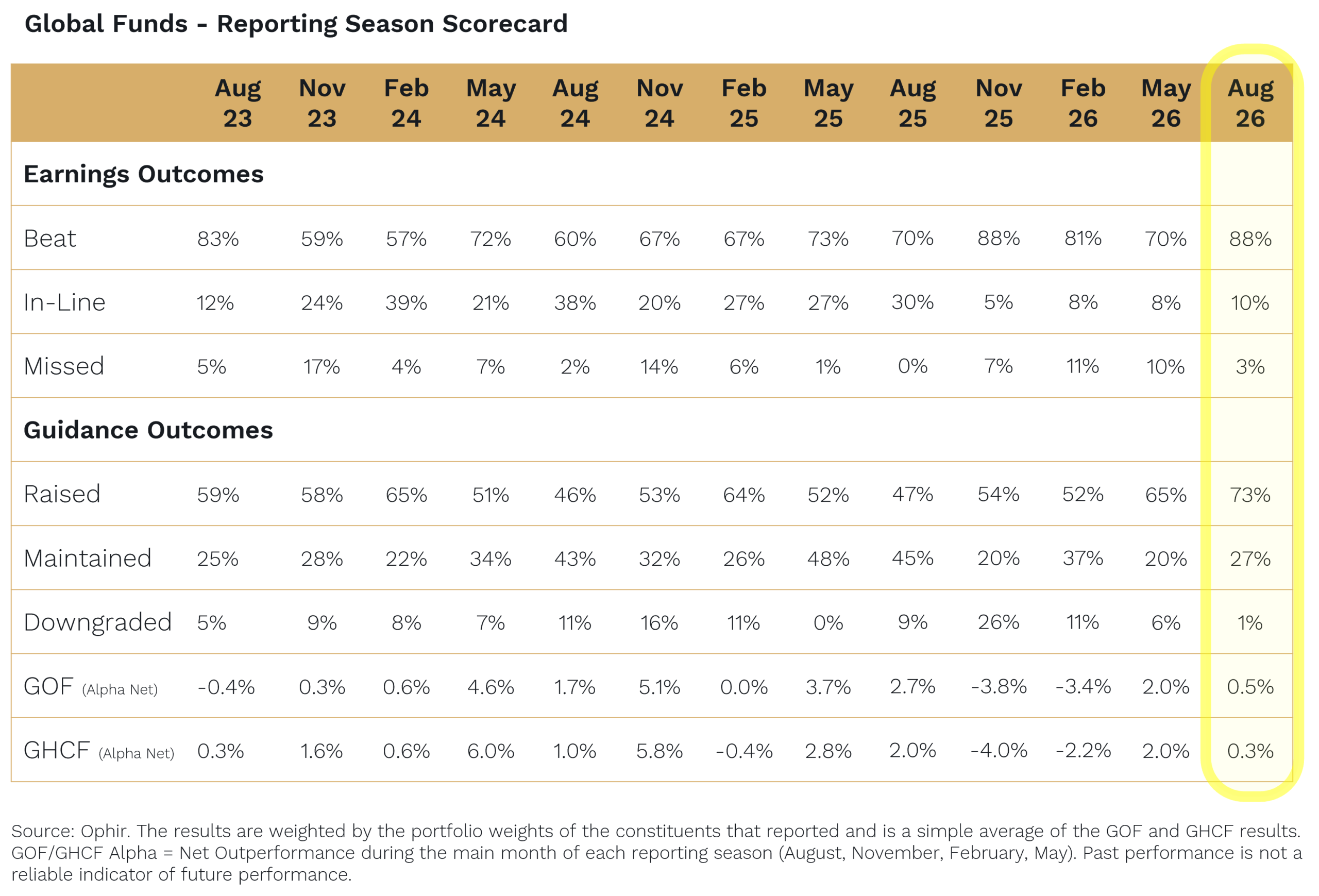
The August 2026 numbers are as good as any we have recently recorded:
- 88% of our companies beat earnings expectations, equal to our best season over this period, and only 3% missed.
- 73% raised guidance, the highest of the 13 seasons we have tracked here, and just 1% downgraded.
That is a portfolio of businesses in good health.
And yet the Fund outperformance line at the bottom of the table for August reads just +0.5% for the Global Opportunities Fund and +0.3% for the Global High Conviction Fund.
Great results, not much reward.
If that sounds familiar, it should, because we saw the same pattern – share prices lagging great earnings results – in February and March this year. Back then, the outbreak of the Iran conflict stole the market’s attention during reporting season. But the following month, April, share prices caught up with earnings.
This time in August, the market’s attention was on the TMT momentum explosion and a surge in gold prices, and our companies’ results were largely lost in the noise. (We look at that explosion, and how our risk management kept us out of the blast radius, in this month’s Letter to Investors.)
We can’t promise, nor are we counting on, a repeat of April. But companies that beat and raise do tend to get rewarded eventually. So if the market bounces we think we have companies well placed to benefit from that bounce. Conversely, if higher rates continue to weigh on market sentiment, we are happy we have a portfolio full of companies that just reported strong fundamentals.
Three key themes
1. Selling the winners
August’s defining feature was profit-taking on the AI trade. Companies that had run hard into their results were sold on good news, and more than US$1 trillion came off the value of US semiconductor stocks in the back half of the month.
Our own portfolio gave us the cleanest example, and we cover it in detail below. Silicon Motion grew revenue 127%, printed a record gross margin and guided the September quarter to another sequential record – and fell around 25% across July and August. Nothing in the result explains the share price. The flows do.
Nvidia is the exception that proves the rule. It reported after the close on 26 August with revenue of US$96.2 billion, more than double a year earlier and about $4 billion ahead of consensus. It guided the current quarter $4 billion above the street. Then it forecast roughly 70% revenue growth for the following financial year, close to double what analysts had pencilled in. The stock rose 8.7% the next day.
But look at what it took. Nvidia had beaten consensus in each of the previous five quarters and its shares had fallen after four of them, with the stock roughly flat since October despite an unbroken record of beats.
The lesson isn’t that good results don’t matter. It’s that positioning does, and there were clearly very crowded parts of the market where a beat and raise isn’t necessarily enough.
2. Where the money went
Money leaving the AI trade had to go somewhere, and August showed where.
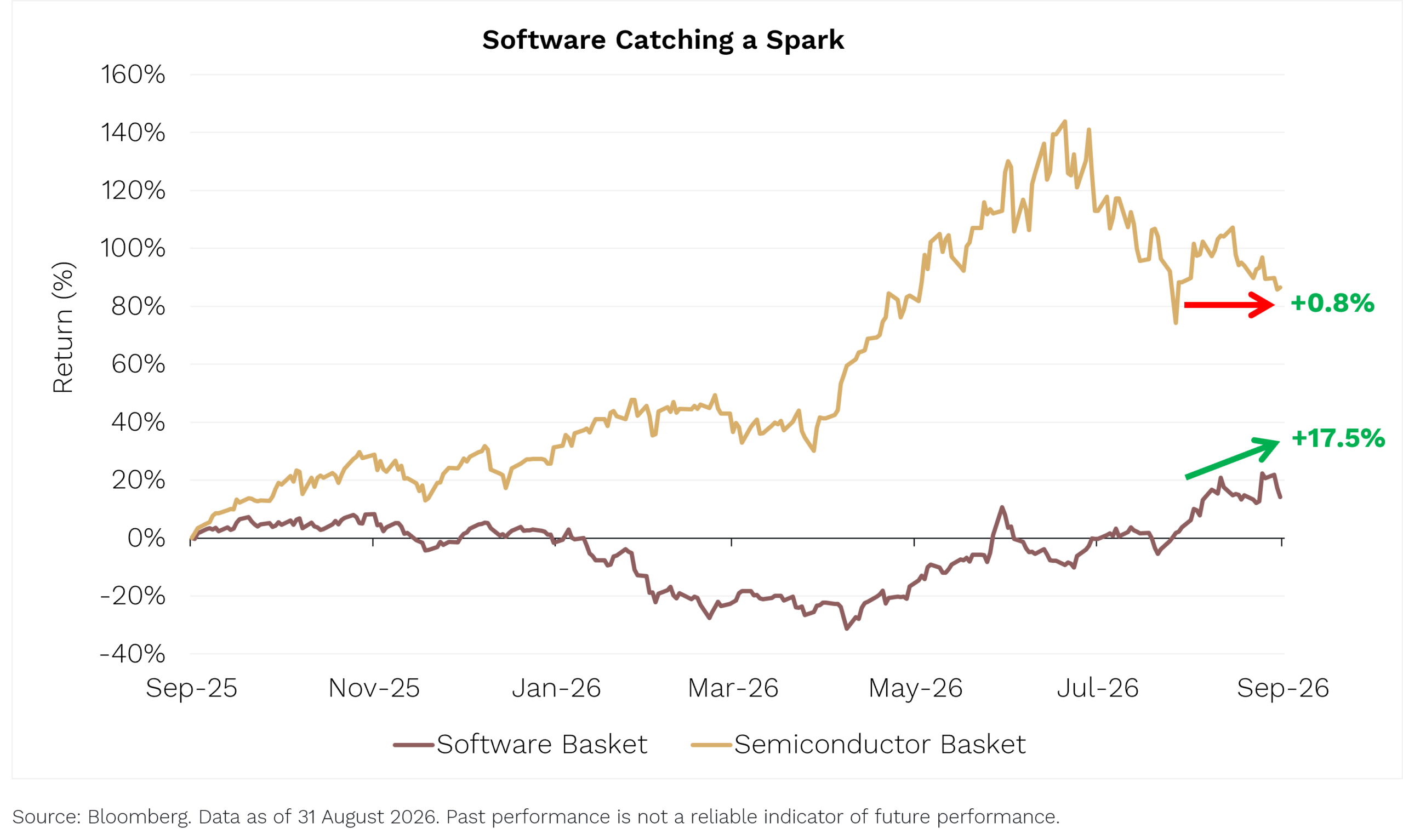
In February we published SaaSpocalypse Now?, arguing that the dispersion between semiconductors and software would keep widening – infrastructure had earnings visibility, while the application layer had an existential question hanging over seat-based pricing in a world of AI agents. The S&P 500 Software & Services index fell more than a third from its October 2025 peak to April, and names like HubSpot, Atlassian and Figma fell 70–80% from their highs. That was right for several months, but the relative trade has found a floor, at least for now.
We still don’t think the debate is settled, but August earnings season was the opportunity for some of those beaten-up software names to demonstrate how they were managing or avoiding the impact of the AI disruption fears.
And that’s ultimately where the incremental dollar started to flow. It meant that across the month the US software basket rose +17.5% – its best August since records began in 1990 – against +0.8% for semiconductors.
Software wasn’t the only beneficiary, as the rotation away from the AI trade was also directed towards healthcare – a sector under pressure for much of the year as negative sentiment led investors to use it to fund the AI trade.
The debate has genuinely shifted. Six months ago software had to prove AI would not destroy its economics; in August several of the largest platforms started proving AI can improve them. We would not declare it over – one earnings-driven squeeze can look like a regime change and then fade, and the sector is no longer cheap. But the burden of proof has moved.
It is also the best argument we know for not making heroic thematic calls. We sat close to index weight in both software and semiconductors through this period, not because we predicted the reversal but because we were honest that we had no edge on the big AI questions. When the pair unwound, most of the blast went past us.
3. Where the money isn’t going
The one place the money did not rotate was the early-cycle trade.
Earlier this year, housing-exposed names, building products, industrial distributors and freight had been among the biggest beneficiaries of the market broadening out. Investors were positioning for a rate-cutting cycle that would pull those end markets off historically low levels of activity.
August turned that on its head. At Jackson Hole, Fed Chair Kevin Warsh left the door open to a rate rise, and Cleveland Fed President Beth Hammack was more direct still, arguing that with inflation near 3% “now is the time to act”. A September rate hike is now priced as a near certainty following strong payrolls data and a largely in-line CPI print that didn’t do enough to ease concerns.
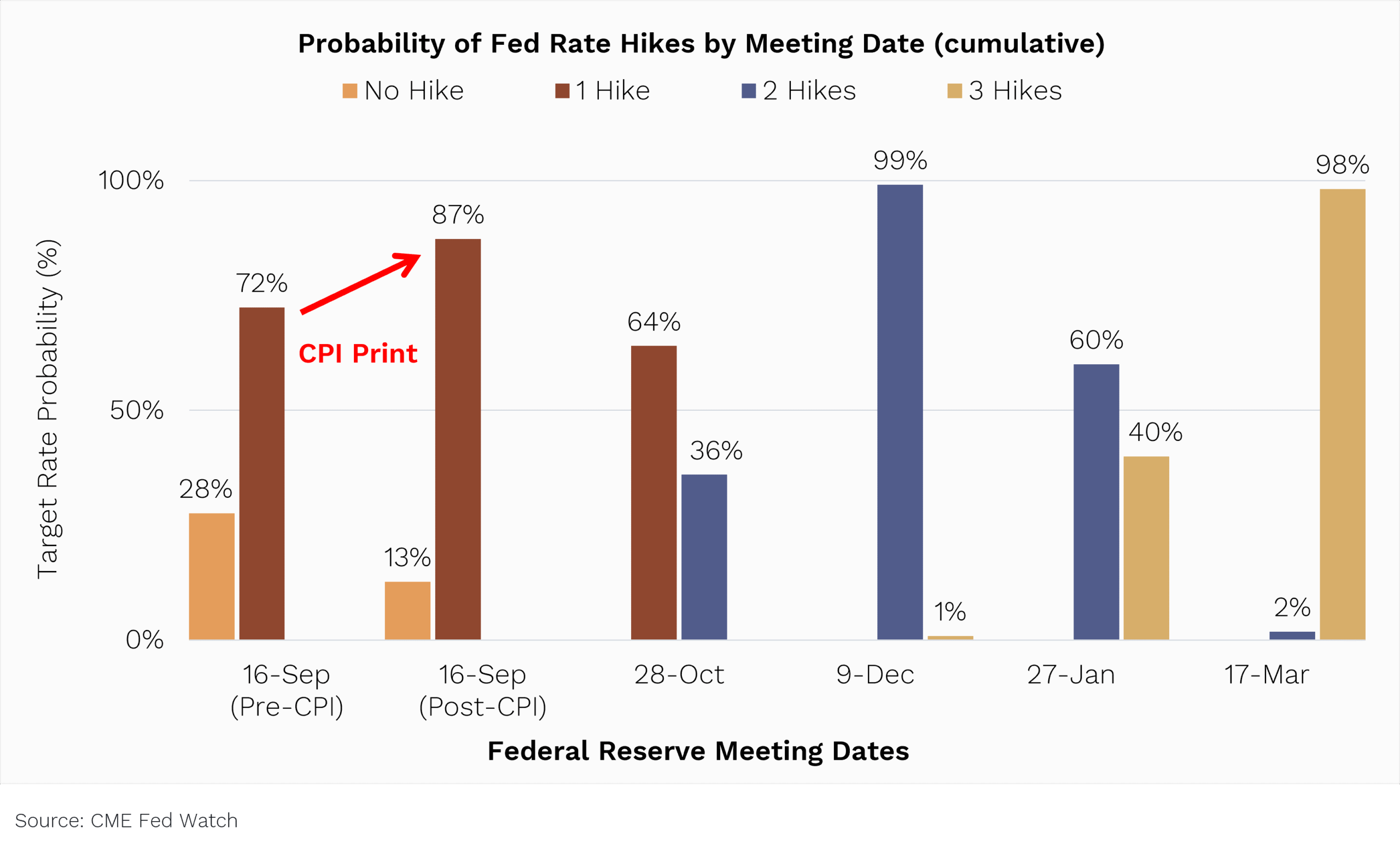
You could see it in the results. Cyclically-exposed companies that reported perfectly good June quarters were marked down on second-half commentary that would have been rewarded three months earlier, because the market has stopped paying for a recovery that now needs lower rates to arrive.
Our response has been to add incrementally to size and liquidity as the market approaches an important decision point and potential regime shift.
Two results case studies (a winner and a loser)
Below we take a closer look at one winner and one loser from the recent results season.
The Winner – Avient (NYSE: AVNT)
Avient is a Cleveland-based specialty materials business – custom colours, additives and inks in one segment, engineered polymer formulations and composites in the other. It sells small volumes of high-value formulations into a long tail of customers, after the better part of a decade divesting commodity volume and buying specialty IP.
The idea came out of a trip to Cleveland earlier this year to test the breadth trade. We wanted to know whether the market’s broadening beyond AI was underpinned by real end-market demand or was simply money rotating out of crowded positions – so we sat down with a long list of industrial and materials companies in one of the densest manufacturing corridors in the US and drilled them on volumes, pricing and order books.
The response was mixed, which was itself the answer. Volumes were not recovering. But pricing was holding, and the businesses with genuine structural growth inside them were compounding regardless. Avient was the cleanest expression of that. We followed up with an onsite CFO meeting and calls with the CEO, and initiated a position in June.
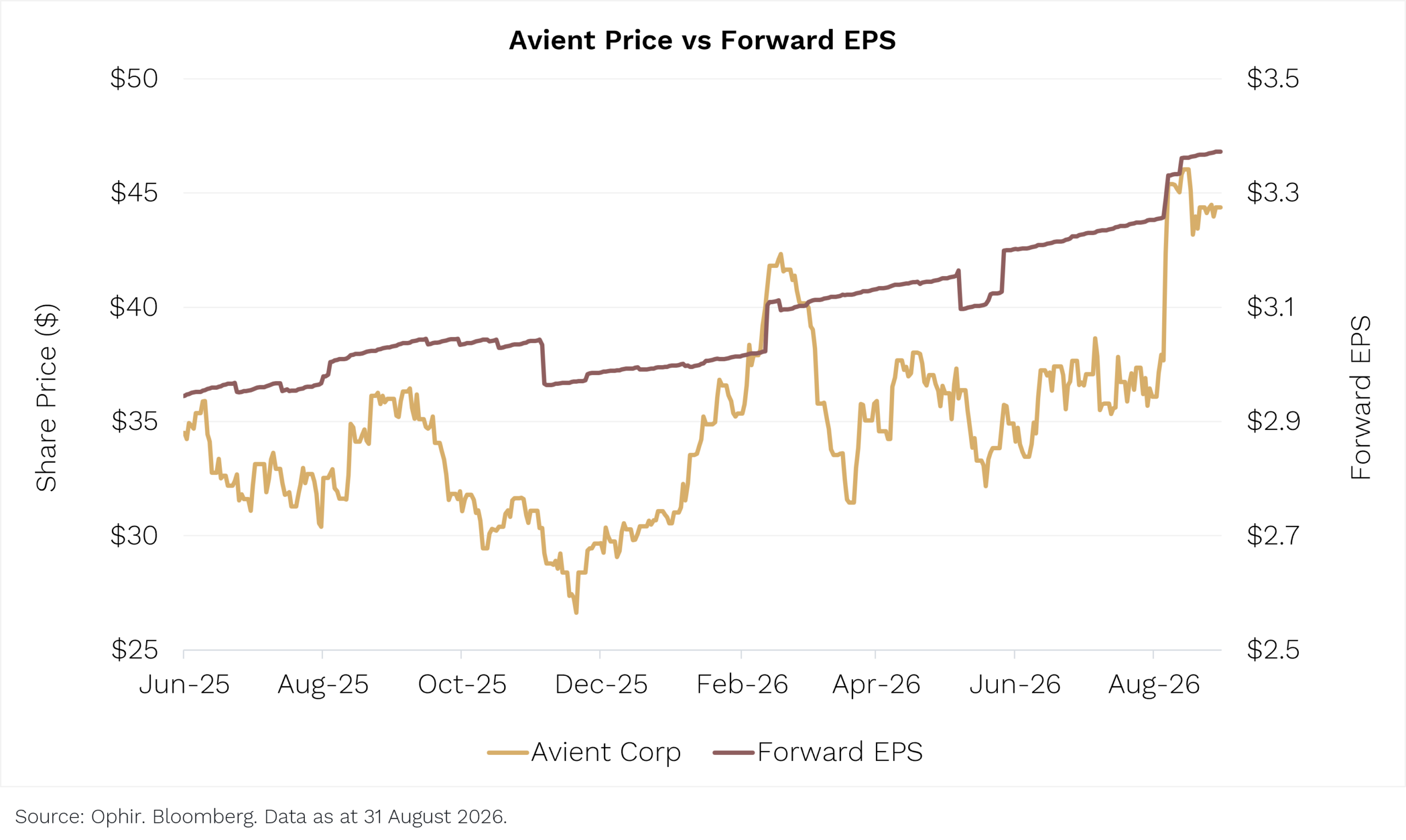
The thesis needed no cyclical recovery. Roughly 20% of the business – healthcare, defence, electrification and non-PFAS packaging – was growing at double digits, and on our numbers those segments alone delivered the revenue growth consensus was expecting. Margins had upside from pricing and reformulation rather than volume. And at 8x EBITDA, a business that sold its low-margin distribution arm three years ago and hasn’t seen an up-market since had never had the chance to re-rate toward the mid-teens multiples its higher-quality peers command.
Do we still own it?
Yes.
Following a strong result the stock popped to a mid-$40s share price, but has given back some of that bounce since the result. It remains well inside the valuation range we think it can support and still at a discount to the specialty peers it now more closely resembles. Leverage will continue to reduce, which provides additional optionality for management. We don’t believe we’re paying anything for a cyclical recovery, and if volumes do recover, this becomes a high-single-digit earnings grower rather than a mid-single-digit one.
The Loser – Silicon Motion (NASDAQ: SIMO)
Silicon Motion is a fabless designer of NAND flash controllers – the small processors that manage how data is stored, retrieved and protected inside smartphones and the solid-state drives (SSDs) that are critical to AI infrastructure.
Why we owned it
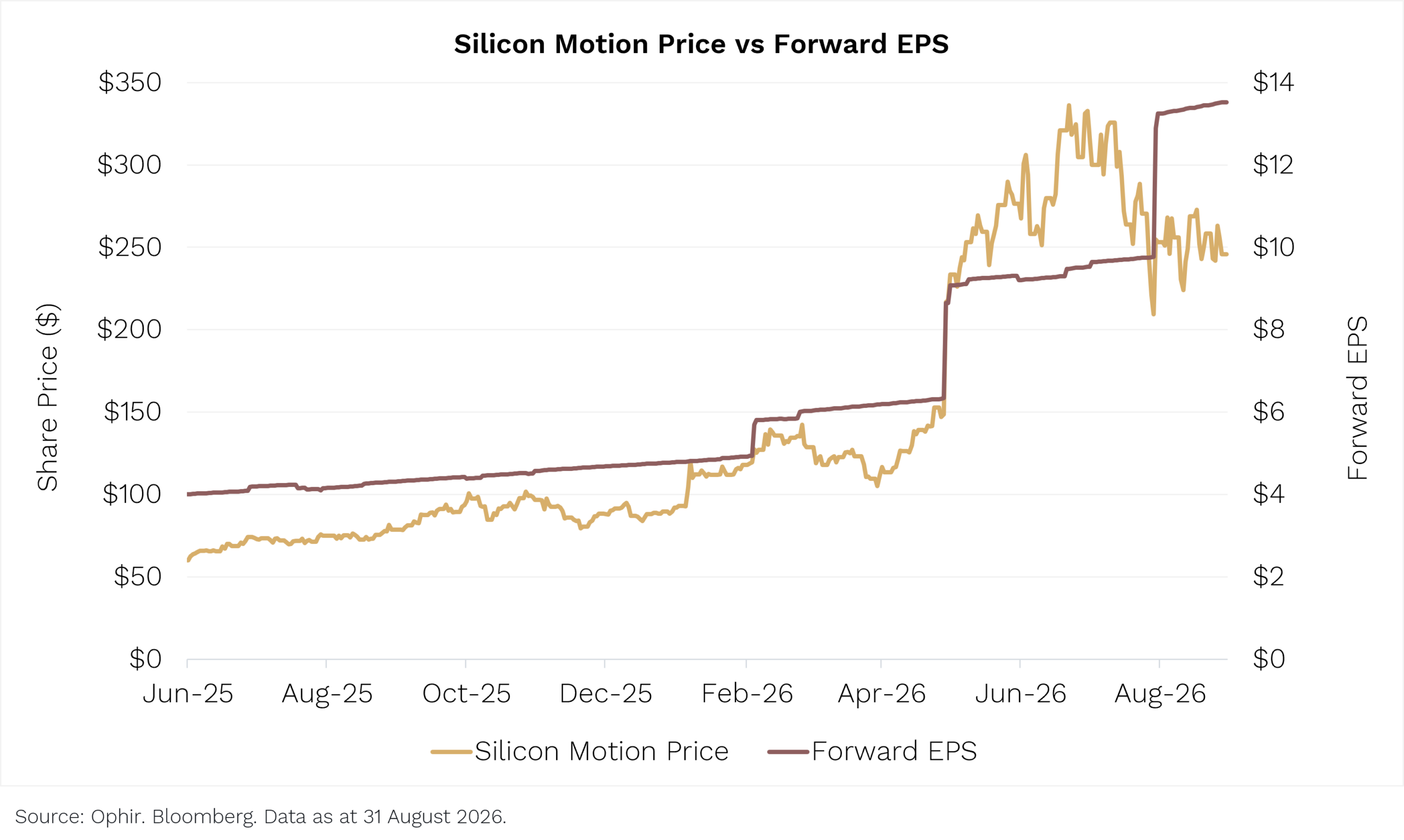
We bought it in June 2025 and wrote it up as our storage exposure in SaaSpocalypse Now? in February. The thesis was deliberately simple: as AI capex ballooned, memory and storage were becoming the bottleneck, and we wanted exposure to the picks-and-shovels layer at a reasonable multiple rather than a view on every turn of the AI cycle. It worked. Revenue more than doubled in the March quarter, the stock went from around $70 to a peak above $330, and it was one of our two standout contributors for FY26.
What went wrong (it wasn’t the result)
The June quarter result was the best in the company’s history. Revenue of $451 million, up 127% year-on-year and 32% sequentially, against the company’s own guidance of up to $411 million, with record gross margins. Management guided the September quarter to $519–541 million, implying another 15%-plus sequential step-up.
But the stock fell anyway, from a mid-July peak of around $320 to trade around $250 for much of August as the market rotated away from momentum and AI winners from earlier in the year.
Do we still own it?
Yes – but at a lower weight.
We had been consistently taking profits while holding Silicon Motion and trimmed further in the June quarter, on the view that when a thematic call works the discipline is not to let the sector exposure keep compounding. Had we run the position at full weight into July and August, the two months would have looked very different for the Funds.
The business itself has not changed. Management expects NAND scarcity to persist to around 2028, and their higher-value products – PCIe Gen5 controllers, enterprise boot drives, automotive Ferri solutions – are now close to 30% of revenue and growing fastest. But we are not going to pretend we saw the last two months coming. In a crowded thematic, the stock and the company can move independently for longer than is comfortable – and trimming a winner on the way up is what buys you the patience to hold it on the way down.
Delayed gratification
Two stocks, two directions, and in both cases the share price told you more about positioning than about earnings.
Avient beat, raised, expanded margins to a record with its biggest region shrinking, and re-rated. Silicon Motion beat by a distance, guided to another record, and fell. The difference was not execution. It was who else owned it.
That is what the whole month looked like. Our companies delivered 88% beats and 73% guidance upgrades – as good a scorecard as we have recorded – and the Funds weren’t rewarded for it.
We have had this happen before, and sometimes you need patience while the gratification is delayed. We would much rather own a portfolio of businesses whose earnings are running ahead of expectations and whose share prices have not yet noticed, than the other way around.