TMT: it’s dynamite
In this Letter to Investors, we look at:
- Why US earnings are surging as if they were recovering from a recession (despite no recession), and how that is helping the share market defy fears and grind higher.
- The biggest two-month blow-up in technology momentum in history, and who was left holding the fuse.
- How our Global Funds’ risk management allowed us to sidestep the blow-up and even outperform.
A young AC/DC warned us about TNT more than 50 years ago. In August, what blew up was TMT: the technology, media and telecommunications stocks at the centre of the AI trade.
For most of this year, investors had gone long (bought) the AI semiconductor winners and bet against (shorted) the software companies AI was meant to disrupt.
In August, the most crowded position in global markets, and a hedge fund favourite, detonated.
You would not have picked it from the headline indices though:
- The S&P 500 gained +2.7% and the Nasdaq Composite rose +4.6%.
- The ASX 200 added +1.7%.
- Our own patch, small caps, did better again. The ASX Small Ordinaries Accumulation Index jumped +5.2%, helped by gold stocks (the ASX All Ordinaries Gold Index rose +28.9%).
- Global small and mid caps rose +2.1% in US dollar terms, but a stronger Australian dollar took most of that back for unhedged investors. In Australian dollar terms our global benchmark, the MSCI World SMID Cap Index, was up just +0.3%.[1]
The factor headwinds that hurt us in July did not let up in August, both here and particularly in the US. (We look at these in more detail below.) So we were reasonably pleased that three of our four Funds outperformed and the fourth lagged only a little:
- The Ophir Opportunities Fund returned +6.8% net of fees against +5.2% for its benchmark, an outperformance of +1.6% and a welcome bounce after a tough July. Since inception in August 2012, the Fund has returned +22.6% per annum after fees.
- The Ophir High Conviction Fund returned +4.5% net of fees, -1.0% behind its benchmark’s +5.5%. When resources and gold rip like that, we are never going to keep pace. The ASX-listed units (ASX: OPH) returned -3.9% as the discount to NTA widened again after narrowing in July.
- The Ophir Global Opportunities Fund returned +0.8% net of fees. Its benchmark, the MSCI World SMID Cap Index (NR, AUD), returned +0.3%, an outperformance of +0.5%.
- The Ophir Global High Conviction Fund returned +0.6% net of fees, +0.3% ahead of the same benchmark.
The two Global Funds were the standouts.
Given the TMT detonation, July and August were about as hostile as it gets for any fund holding momentum stocks. That includes our Global Opportunities Fund, which had returned +31.8% for the year to 30 June 2026.
The fact that the Fund got through the two months without giving much back is a testament to our risk management. (More on that below.)
A post-recession earnings explosion, with no recession
Before we get to the TMT fireworks, a word on the fundamentals driving the market higher.
Many investors and commentators remain sceptical that the US market can keep rising. But there is a powerful reason it is continuing higher.
The chart below shows how fast expected earnings for the next twelve months (NTM) are growing for S&P 500 companies, year on year, going back to the late 1990s.
The current growth rate is close to +40%.
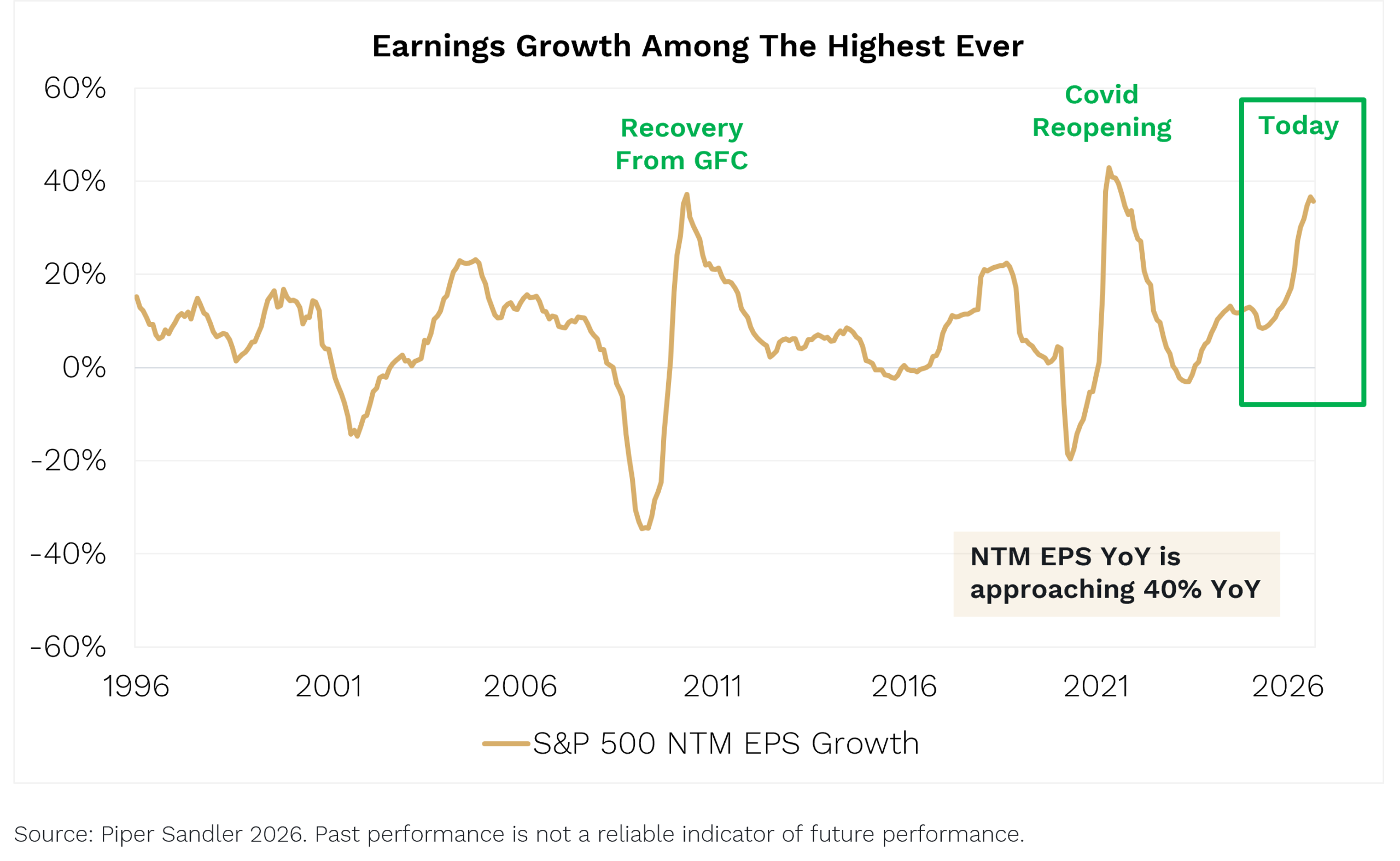
It has only been that high twice before: coming out of the GFC in 2010, and in the COVID reopening of 2021.
Both were rebounds out of a recession, so +40% growth off a depressed base was less impressive than the number suggests.
This time there was no crater and no recession. US earnings are accelerating from a base that was already high, a much rarer beast.
The recently completed June quarter US reporting season backed that up. A whopping 86% of S&P 500 companies beat earnings estimates, the highest proportion since the 2021 COVID reopening. Much of this came from the AI capex boom continuing to beat expectations and spreading to the second- and third-order beneficiaries of that investment.
Regular readers know our mantra: over the long term, share prices follow earnings. Right now, earnings growth is underpinning the US share market.
The rub is that an economy this strong can keep inflation sticky.
At Jackson Hole in late August, the new Fed Chair, Kevin Warsh, left the door open to a rate rise. The market’s odds of a September hike went from about one in three to two in three.
Even so, we would rather own small caps in a hot economy with a wary Fed than in a weak economy that needs rate cuts.
Momentum in tech: watch it explode
Now to the fireworks.
Momentum investing is simply buying what has been going up and selling (or shorting) what has been going down. It works beautifully for long stretches, right up until everyone tries to flee through a narrow exit at once.
As mentioned, this year the TMT momentum trade has been a pair:
- Long (buying) the AI winners: semiconductors, memory and AI infrastructure.
- Short (selling) software, particularly the SaaS (software-as-a-service) businesses AI is supposedly going to disrupt.
The chart below shows the rolling 60-day drawdown of that pair going back to 1999, when the data starts.
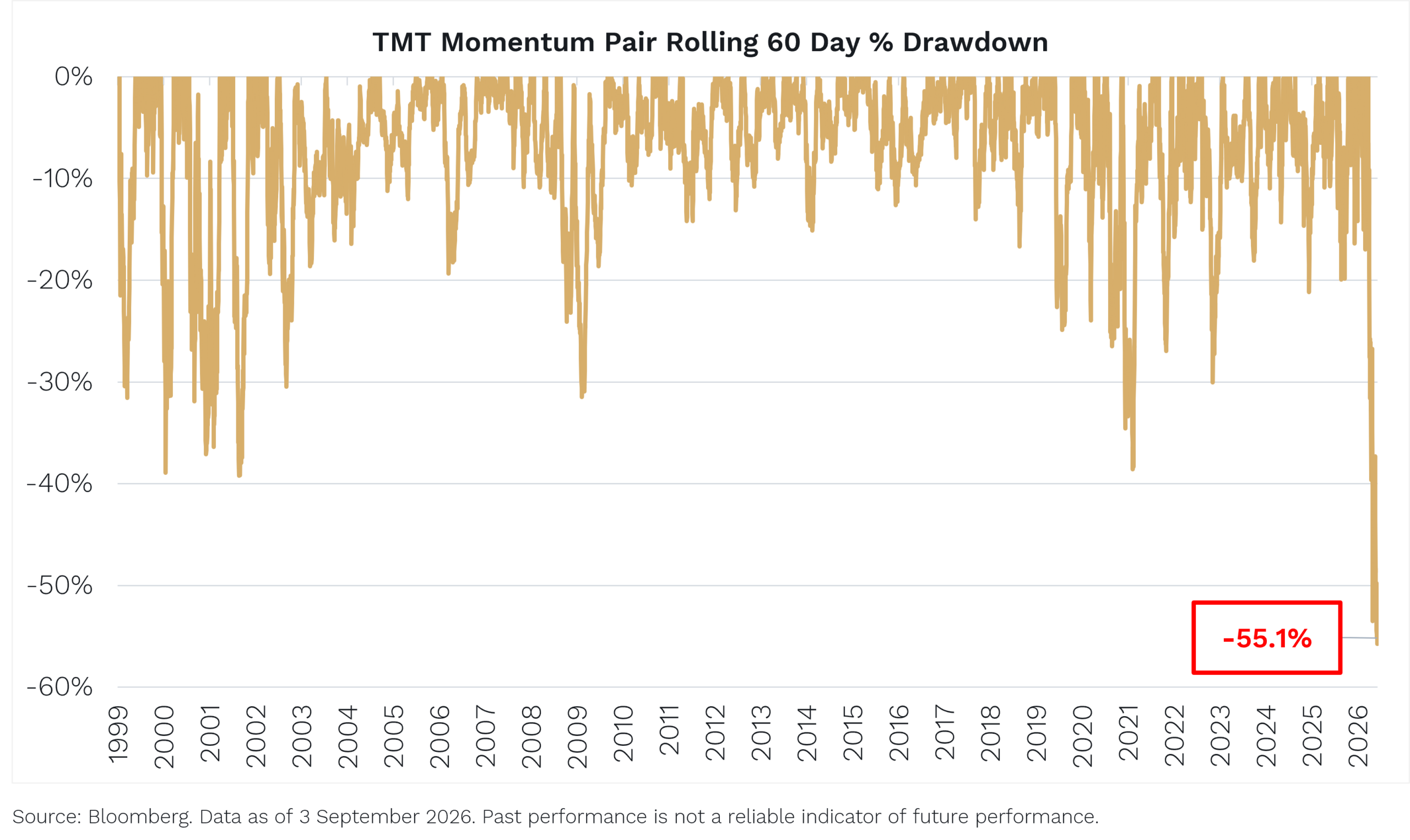
Over July and August, the pair fell -55%.
Nothing in more than 25 years comes close. Not even the dotcom bust.
Split the pair into its two legs and the picture gets clearer.
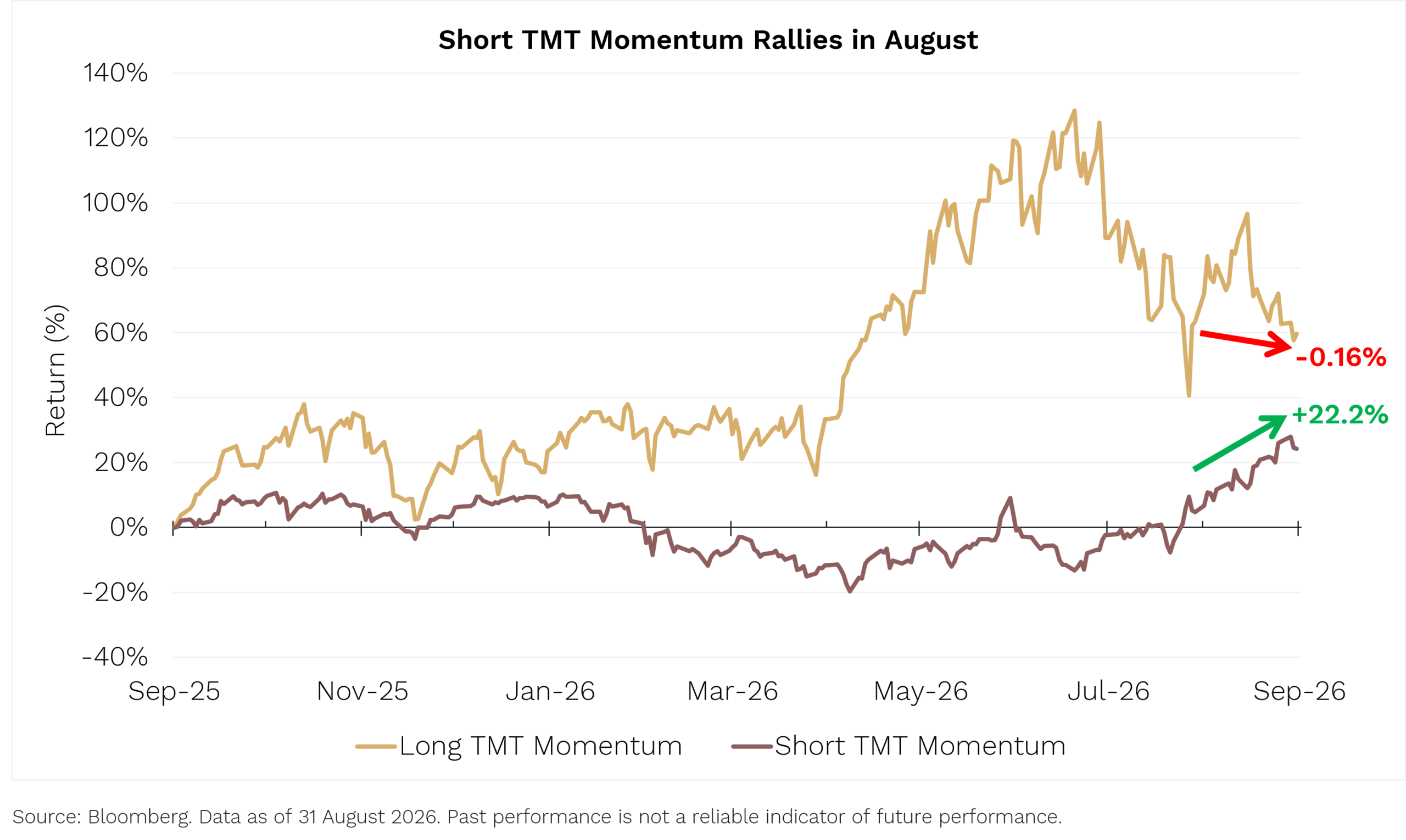
The long leg (the gold line) had been leaking since late June. But the real damage in August came from the short leg (the red line). The stocks people were short, mostly software, jumped +22.2% in a single month.
The US software basket rose +17.5% in August while the semiconductor basket managed just +0.8%.
More broadly, software had its best August since records began in 1999, and more than US$1 trillion came off the value of US semiconductor stocks in the back half of the month.
What lit the fuse?
Most likely a combination of extremely crowded positioning, a valuation gap between the two camps that had stretched about as far as it could, and a handful of software results suggesting AI might be helping these businesses rather than knocking them off.
Once the short leg started moving, forced covering by hedge funds did the rest.
How our Global Funds used risk management to avoid blowing up too
So how did our Global Funds get through a month like that with a small outperformance rather than a large hole?
We had not made any big thematic calls. We had not bet everything in either direction, overweight semis or short (or underweight) software.
As we have said before, we have no edge on the big AI questions. Will the memory shortage last? Will agentic AI hollow out the software incumbents? What will open-source model providers, in China or at Meta, do to token pricing?
We do not know, and we are not convinced anyone has an edge on those questions, or on whether the market has priced them correctly.
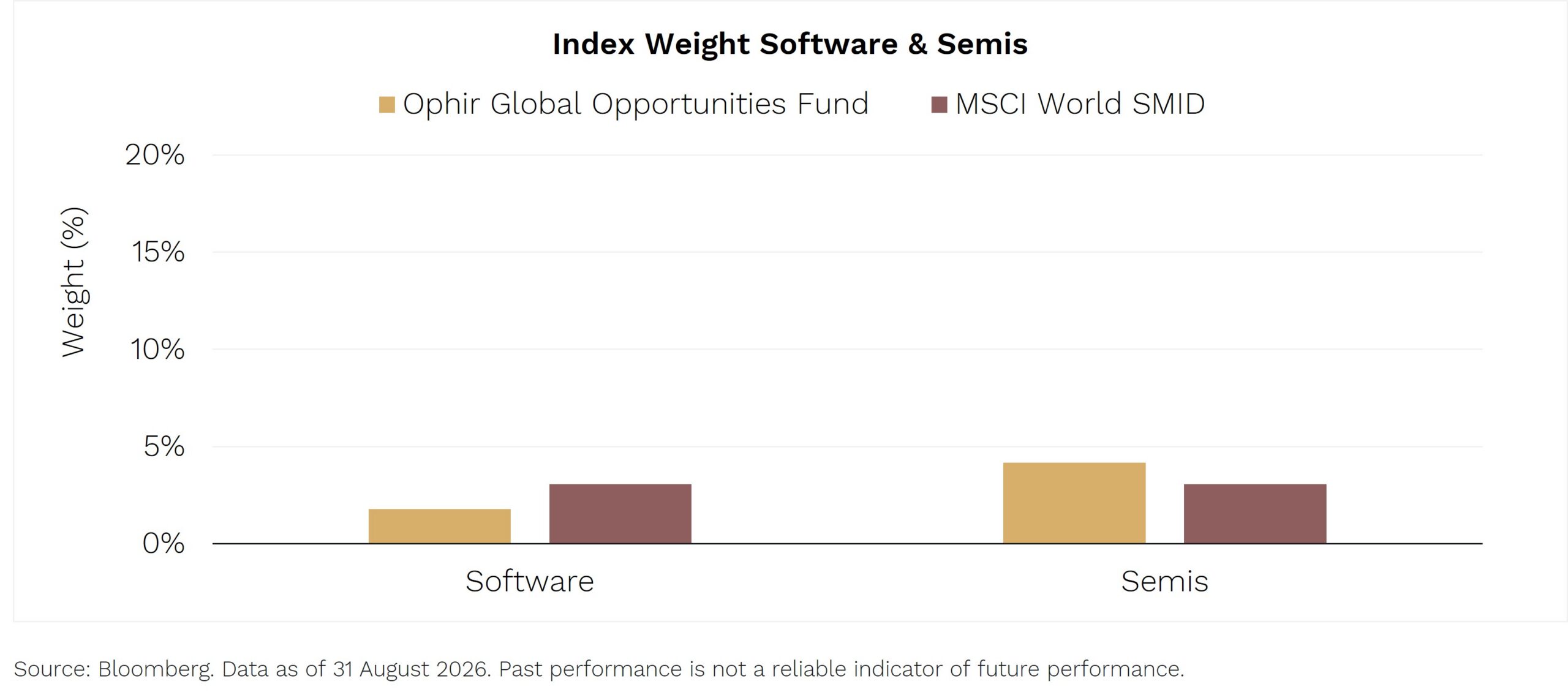
The chart above shows the Ophir Global Opportunities Fund’s (GOF, in yellow) weight in software and in semiconductors against its benchmark.
We sit close to index weight in both. So when the pair blew up, most of the blast went past us.
One big heroic thematic call has never been part of our investment process. Our returns have always come from individual companies with their own idiosyncratic earnings drivers.
Keeping out of the TMT blast radius
July and August were one of the most violent periods for technology momentum in decades. Our Global Funds came through relatively unscathed.
We would love to claim we saw it coming. We did not. We just never went all in.
As always, investing in shares is a long-term endeavour and a month or two tells you very little. Investors in our Funds should have a time horizon of at least five years.
We will keep doing what we do: hunting for idiosyncratic small caps whose earnings the market has not yet found, at a safe distance from the dynamite.
If you would like to chat to us about any of the Funds, please call us on (02) 8188 0397 or email ophir@ophiram.com.
Thank you for entrusting your capital with us.
Kindest regards,
Andrew Mitchell & Steven Ng
Co-Founders & Senior Portfolio Managers
Ophir Asset Management
[1] For investors concerned about further appreciation in the Australian dollar, our Global Opportunities Fund is also available in a currency hedged version [factsheet].