SOX on Sale: Staying disciplined through July’s AI rout
In this Letter to Investors, we look at:
- The worst month for semiconductor stocks since the GFC, and why the broader US market barely blinked.
- How our Global Funds avoided the fate of momentum-chasing peers during the semis sell-off by successfully implementing downside risk management.
- The stock picking that still added value in a brutal month for our style.
- US business activity surveys hitting their highest level since 2022, and why that is good news for small caps.
- Why we believe the small-cap earnings upgrade cycle may have further to run.
Warren Buffett once quipped: “You only find out who is swimming naked when the tide goes out.”
If all you were riding at the start of this year was the semiconductor and memory AI trade, you looked like a stock-picking genius.
But then, suddenly, in July, the tide went out. And it revealed those who’d forgotten to put on their bathers before hitting the water.
In July, the Philadelphia Semiconductor Index (ticker: SOX) suffered its worst month since the GFC. US semi stocks fell more than 20% and some memory names nearly halved.
Take Sandisk. Yes, the company behind the SD cards and thumb drives you probably have in a drawer, and a big beneficiary of the enormous demand for memory created by AI large language models.
Sandisk was the best-performing small-cap stock globally for the year to June 2026. It grew from about a US$6.5 billion market cap to a $337 billion market cap – cracking 50-bagger status (a more than 50-fold increase in market value) in less than 12 months.
But by late July it was worth just $150 billion – cut by more than half!
Despite this carnage, the S&P 500 finished the month down just -0.1%. (Trivia for your next dinner party: that was its first negative July since 2014, snapping eleven straight July gains.)
Under the surface, money was moving at pace out of the year’s hottest trade and into almost everything else. Around 59% of S&P 500 companies actually rose in July, and the equal-weight version of the index (where each stock gets the same weight irrespective of market cap) gained about +1.0%.
At home, the ASX 200 added around +2.2% for its fourth straight monthly gain, one of the better results among developed markets.
Small caps, however, had a tougher time. Our Australian benchmark, the S&P/ASX Small Ordinaries Accumulation Index, fell -3.2%; while our global benchmark, the MSCI World SMID Cap Index (in Australian dollar terms), fell -2.4%.
All four of our Funds underperformed their benchmarks in July. We are not, however, overly concerned for two reasons:
- In the Aussie Funds, last year’s big winners simply gave a little back in July, while the local market offered fewer unloved names to recycle capital into than our Global Funds had available.
- And in our Global Funds, July represented one of the stronger months of relative downside resilience we have experienced in years, despite underperformance – below we explain why.
SOX on Sale
First, the scene of the accident.
From January to late June this year, the AI trade went close to vertical.
The Philadelphia Semis Index, the Korea Stock Exchange (home to the big memory manufacturers Samsung and SK Hynix), and US tech momentum stocks were all up roughly +100% or more at their peaks.
In July, as mentioned, a big chunk of those gains disappeared in a matter of weeks.
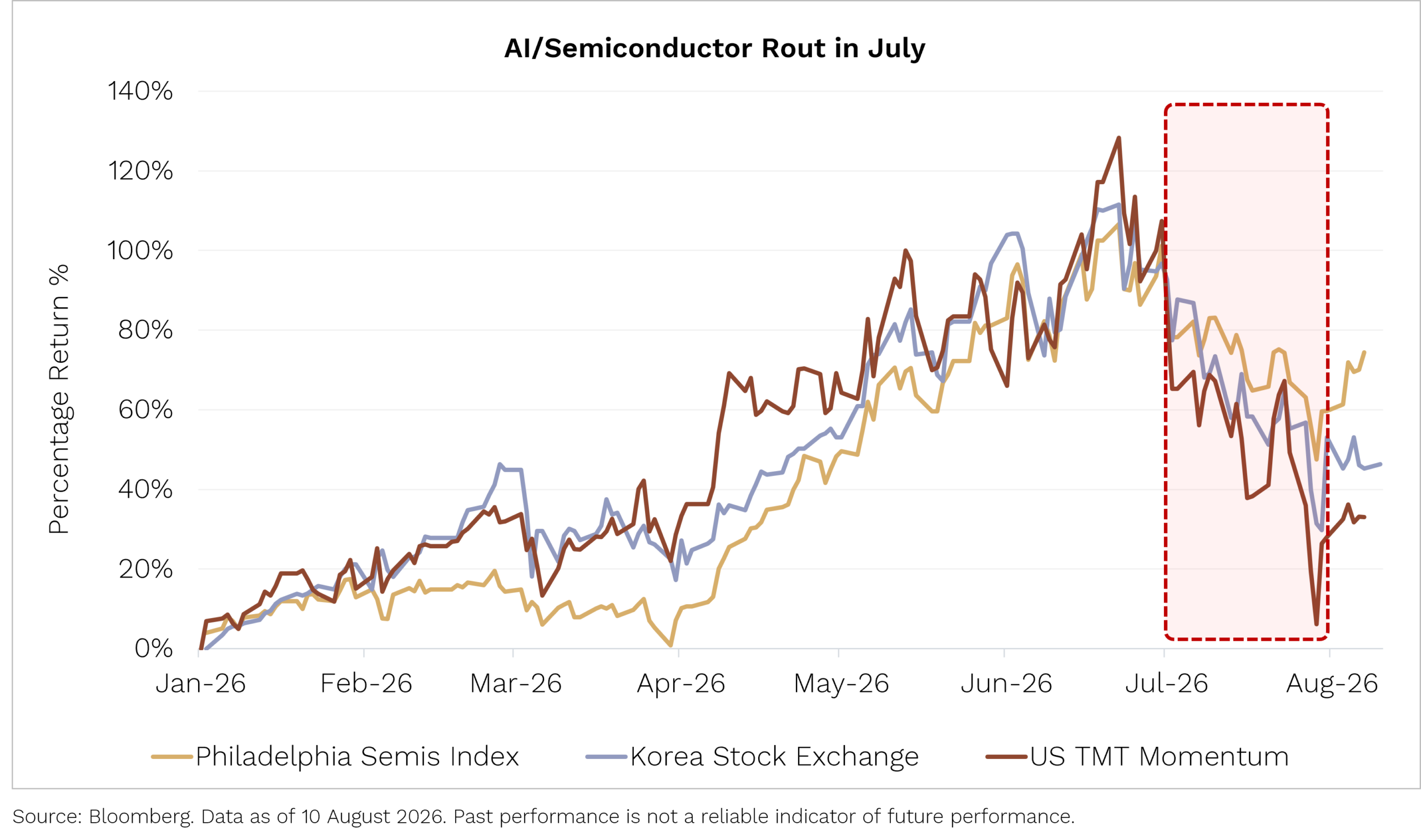
What caused the savage sell-off? A murderers’ row of suspects:
- Crowded positioning.
- Stretched valuations in the most speculative corners of the AI trade.
- Question marks over whether AI capex will pay off.
- A US Federal Reserve that turned more hawkish on inflation late in the month.
Here is the part we find most interesting. The correlation between US AI stocks and the rest of the market collapsed. In fact, during July it went NEGATIVE for the first time in the decade-plus history of the data: that is, while the rest of the market rose, AI names fell.
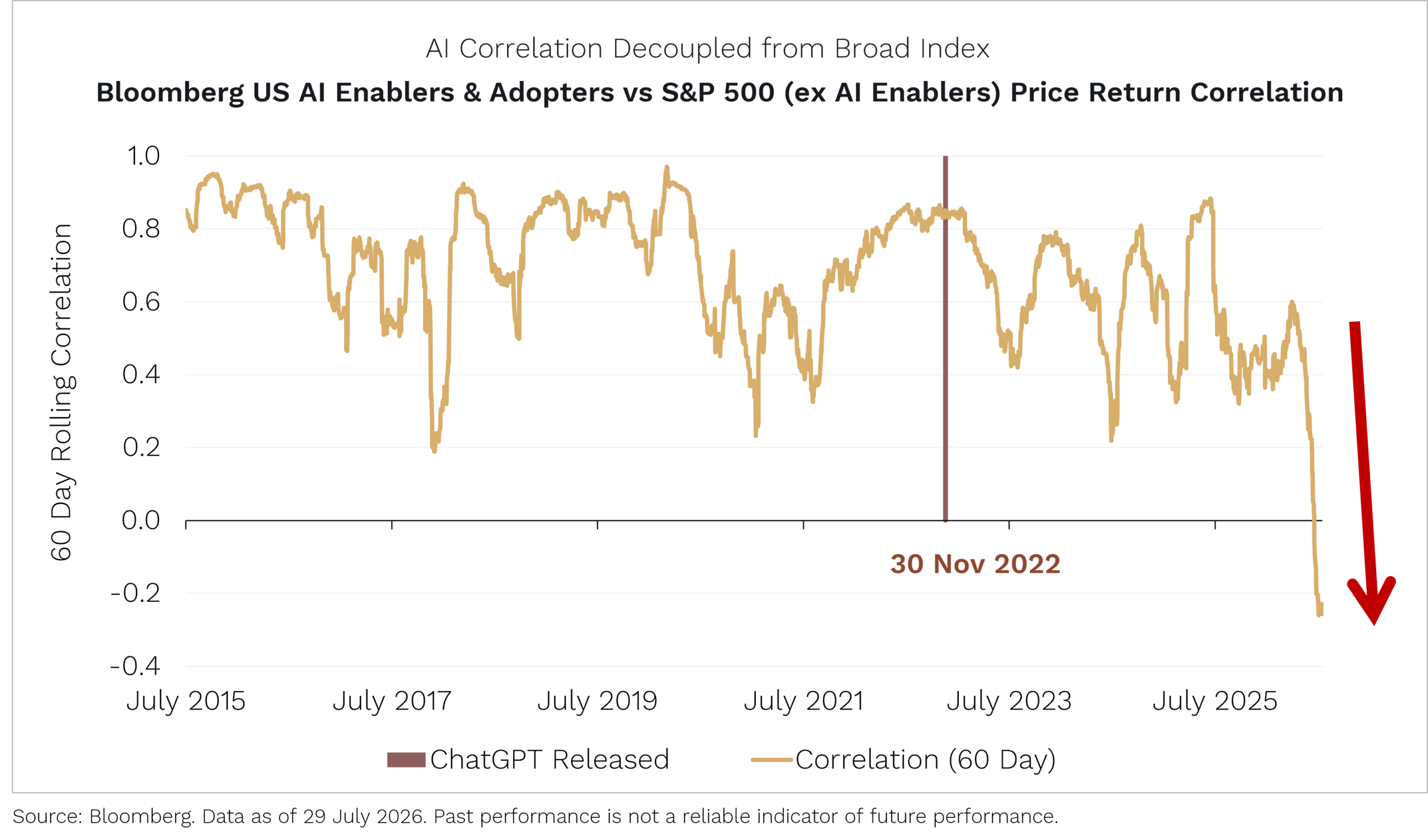
To us, that reads as rotation. Investors took profits on the AI trade and spread the proceeds across the rest of the market. After two years of complaints that a handful of AI winners were carrying every index, breadth is finally improving.
For stock pickers in small caps, that is welcome news.
No AI overweight in Global funds, no worries
Regular readers (and webinar watchers) will know our stance on semiconductors and memory: we hold roughly the index weight, around 8-10% in our Global Funds, and no more.
That’s because we have no edge on the big structural question of where the AI capital expenditure cycle lands. Where we do have an edge is in the handful of individual AI-related companies where our research legwork tells us something the market hasn’t priced.
That discipline felt slow in the first half of the year as we watched semis and memory stocks soar. But in July our discipline paid off.
The chart below shows July and year-to-June returns for a selection of the global small- and mid-cap funds available in Australia. As you can see, some funds that shot the lights out in FY26 (year to June 2026 – right chart) were body-slammed in July (left chart). One peer that beat us and returned nearly +80% for the year fell almost -18% in a single month!
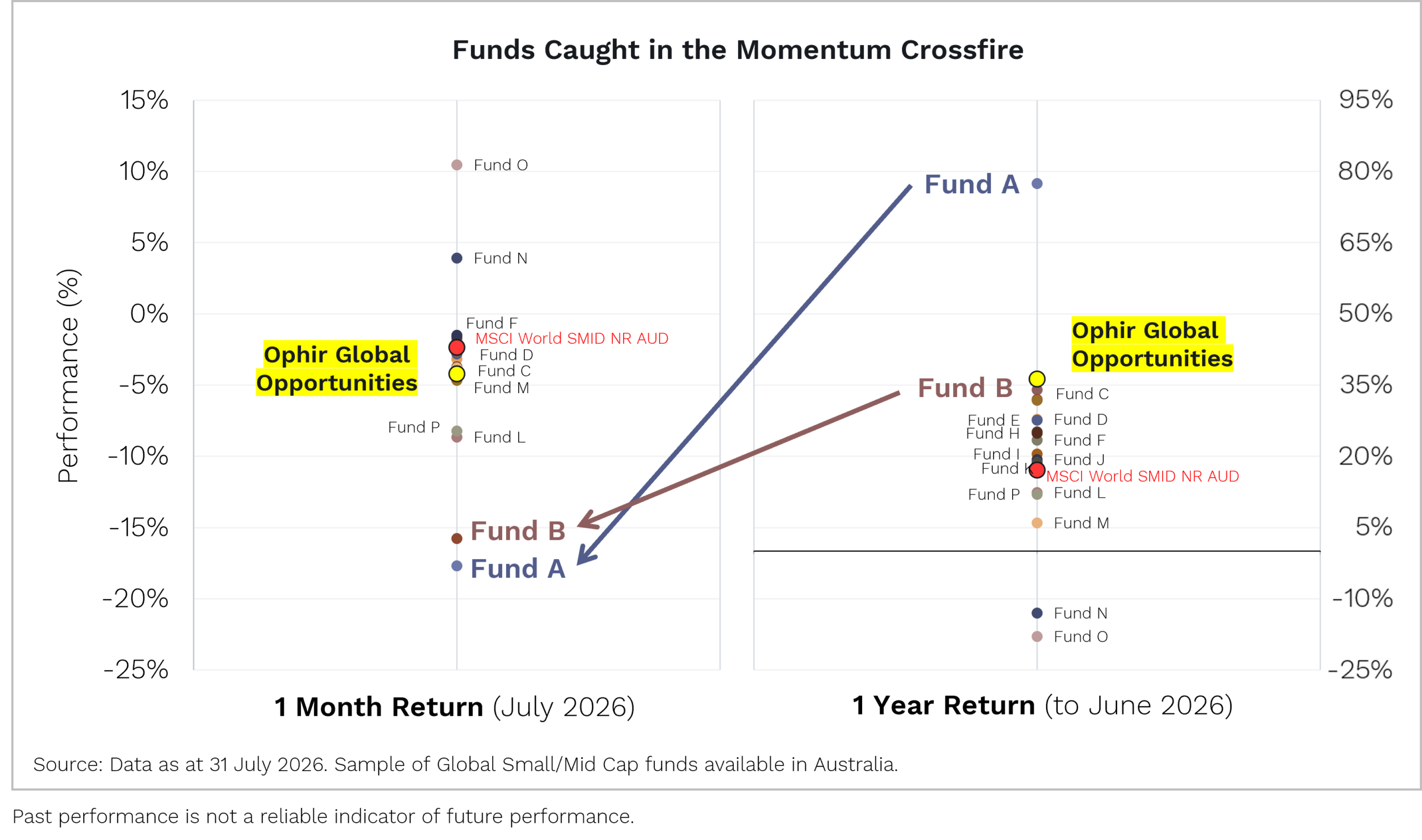
Our Global Opportunities Fund was a top performer over the year to June and middle of the pack in July.
When small caps sold off in July, it was particularly pleasing that we kept most of the strong gains we made in the year to June.
It again goes to show we didn’t generate those returns to June by just riding the AI wave and relying on getting that one call right.
How our Global Funds successfully protected FY26’s big gains
Hang on. The Fund underperformed by 1.9% in July and you’re pleased?
Fair question. Here’s our answer.
The Global Opportunities Fund returned +31.8% after fees in FY26 versus +16.0% for its benchmark. A year like that loads a portfolio up with momentum whether you like it or not: your winners keep growing as a share of the fund. We trimmed those winners consistently as we went.
Even with those big winners in the portfolio, the Fund fell just 1.9 percentage points more than its benchmark (-4.3% versus -2.4%) in a month when momentum stocks were sold off harder than at any point in years.
We are proud of the composition of that result.
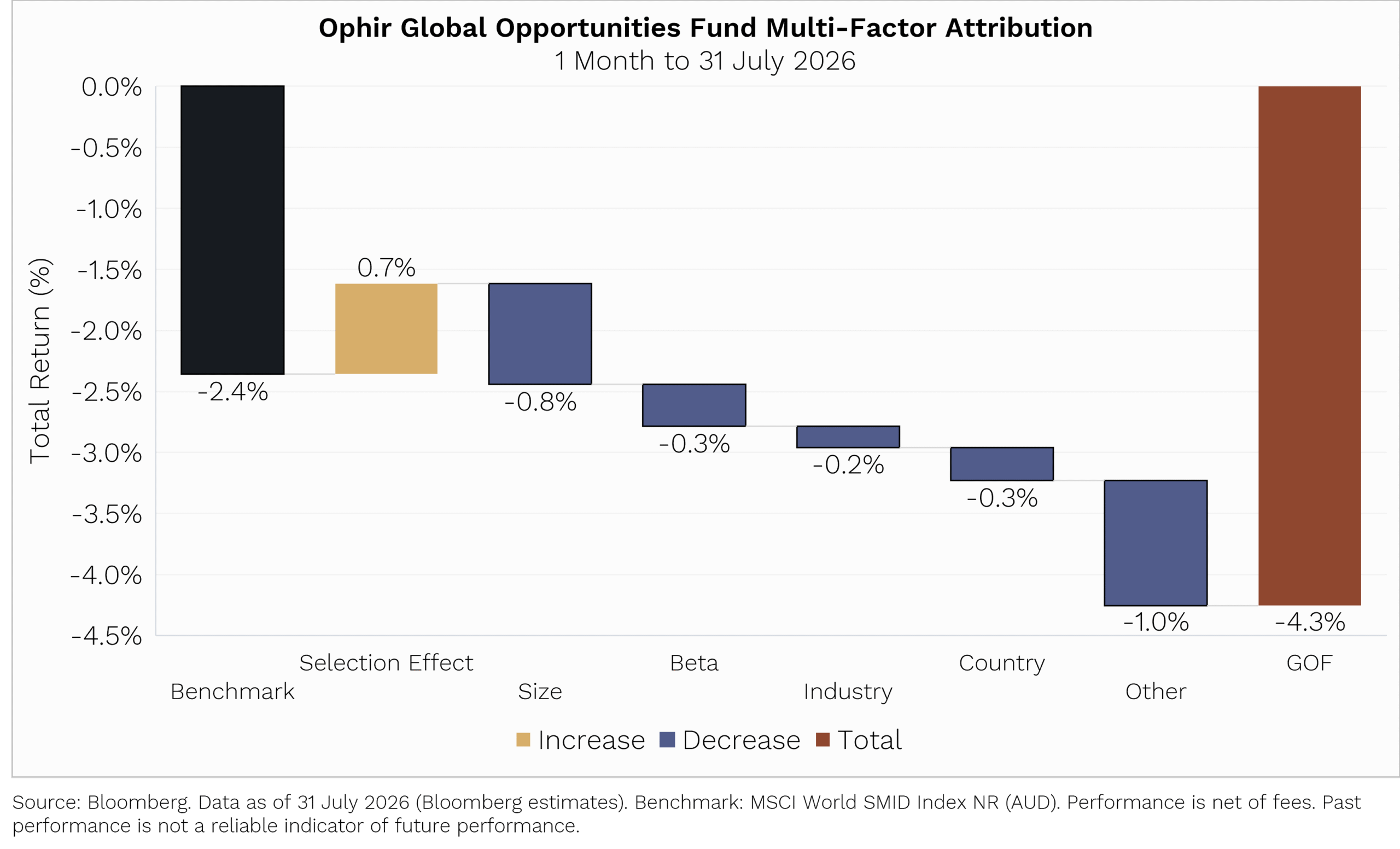
The drags came from factor exposures: Size (smaller stocks where we shop fell more), growth (which underperformed value as energy, financials and real estate ran), beta, and momentum-related effects that inevitably accompany a portfolio of fast-growing small caps after a big year.
But look at the gold bar. Our Selection Effect – the value added purely by picking the right stocks – was +0.7% in July. Even in a month where the style headwinds were near gale-force, our stock picking still worked.
And industry positioning cost us just -0.2%. If we had carried an overweight to semis, that number, and the month, would have looked far uglier.
Over the past four years we have improved our risk-management framework, and a central focus has been downside protection. Months like July are a test of whether we’ve succeeded, and we think the Funds passed successfully. Indeed, at the time of writing in mid-August, the Global Funds have already recouped almost all of July’s fall and underperformance.
As a reminder, though: investing in shares is a long-term endeavour, and one month, good or bad, tells you very little. Investors in our Funds should have a minimum time horizon of at least five years.
US business expansion data bodes well for small caps
While the AI trade was wobbling, the US economy was quietly doing something it hadn’t done in years.
The ISM Manufacturing PMI (Purchasing Managers’ Index, a monthly survey of US business conditions) printed 55.6 in July, its highest reading since 2022.
If we average manufacturing and services surveys, US business activity is now clearly back in expansion territory after hovering around the neutral 50 mark for the better part of three years.
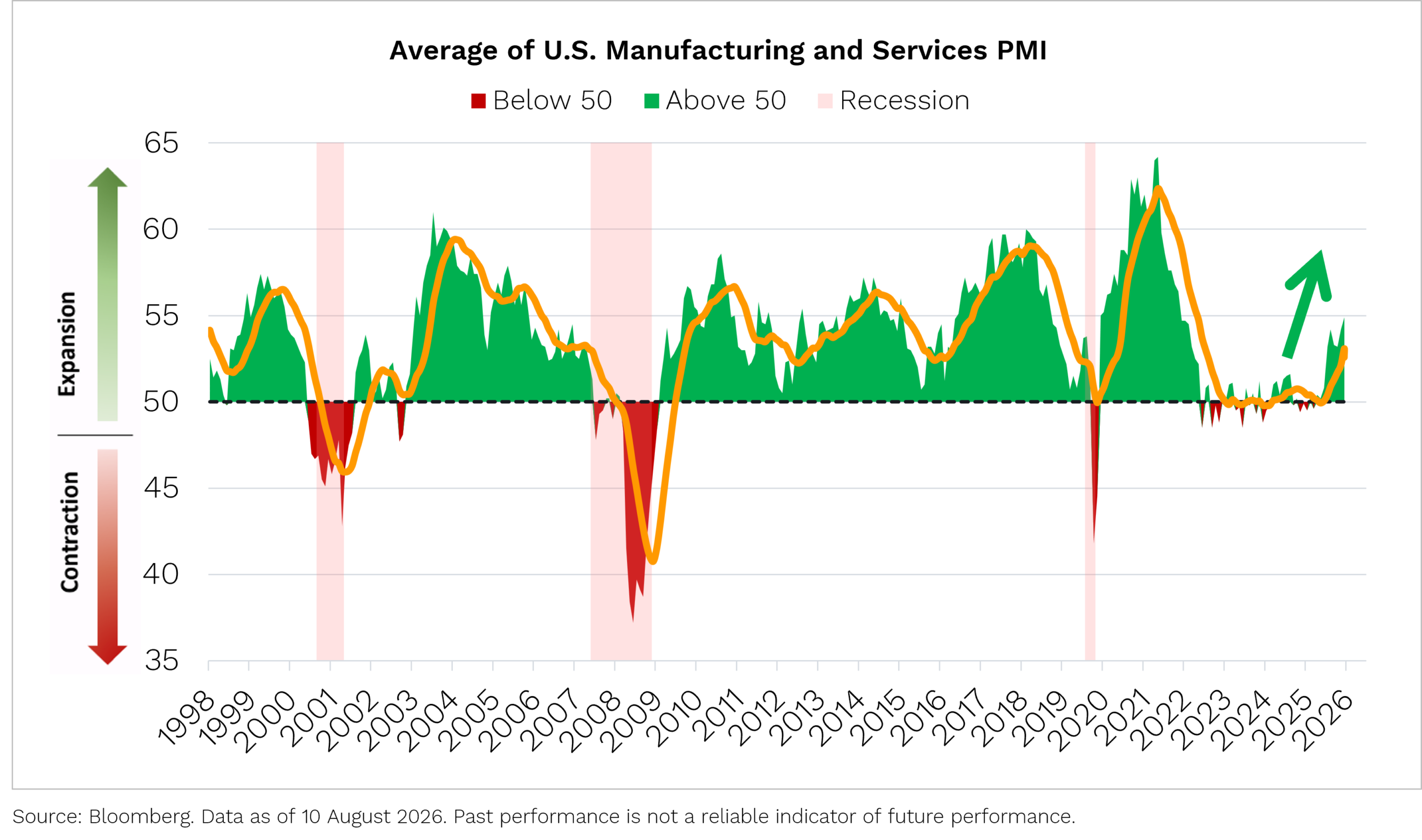
If that growth continues and the Federal Reserve eventually cuts interest rates, history suggests that combination provides rocket fuel for the most economically sensitive part of the share market: small caps.
We are not there yet. More rate cuts may be some way off, and the Fed’s recent hawkish tone reminds everyone the path won’t be smooth. But the direction of travel in the real economy is encouraging.
Why we believe small-cap outperformance may continue
Better still, the improvement is showing up where it matters most to us: earnings!
After years of moving sideways, a US small-cap earnings upgrade cycle kicked off in the latter part of last year. Forward earnings expectations for the S&P 600, the main US small-cap index, have now risen by +31% since the start of 2024 – with the uptrend starting late last year. This is capturing investors’ attention.
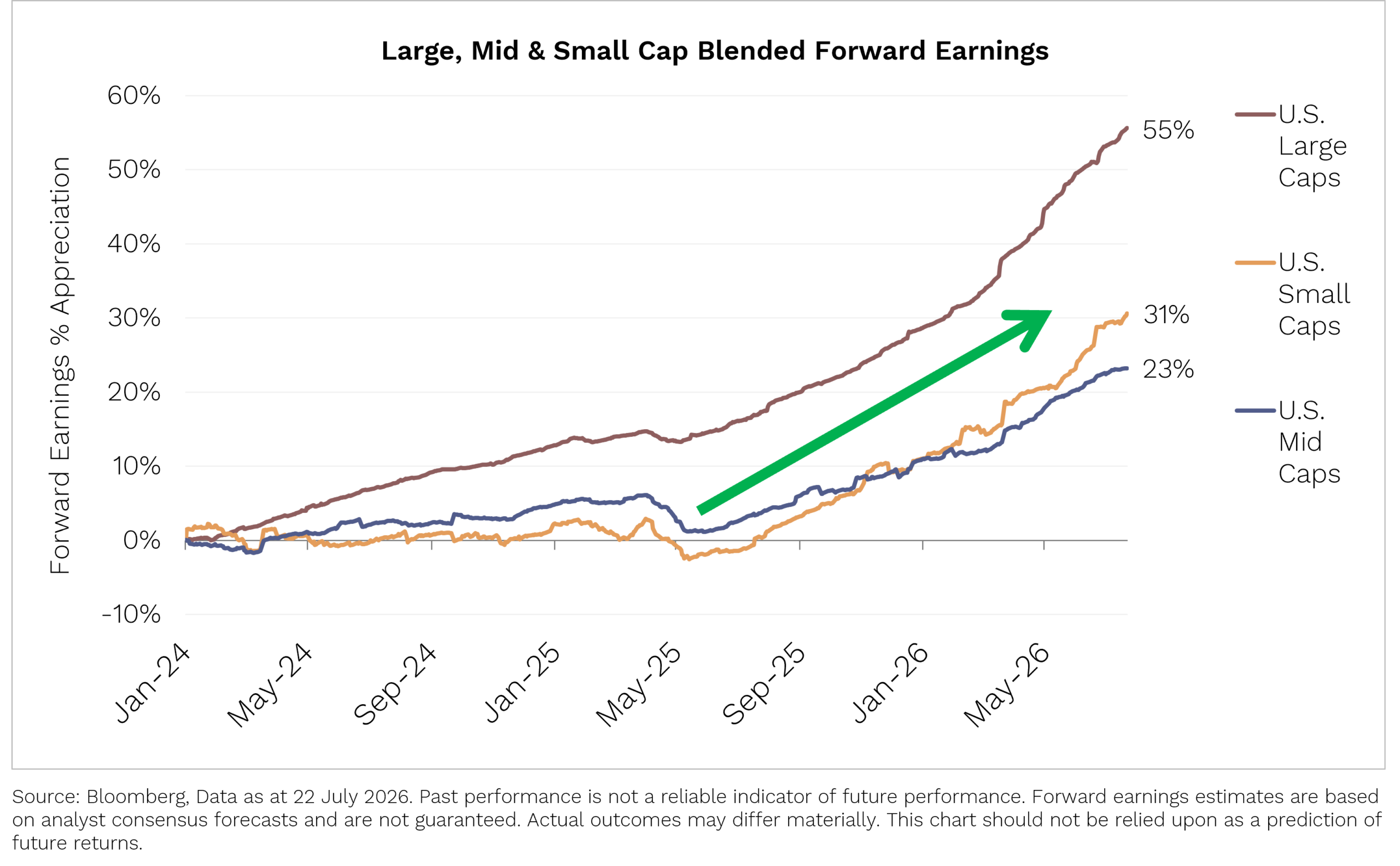
Famed investor Peter Lynch said a company’s earnings and its share price are 100% correlated over the long term. The same holds for whole segments of the market.
Earnings upgrades have been the fuel behind US small caps outperforming large caps since late last year, and we think that story has further to run.
Why?
The PMIs and US small caps’ earnings are finally lifting because of 1.75% of rate cuts by the US Federal Reserve over the last two years, as well as tax cuts for households and businesses put in place by the Trump Administration last year.
So, absent any big rate hikes (the one 0.25% Fed hike priced by the market over the next year won’t be enough to change the picture) or exogenous shocks like wars, this small-cap tailwind in the US likely has further to go.
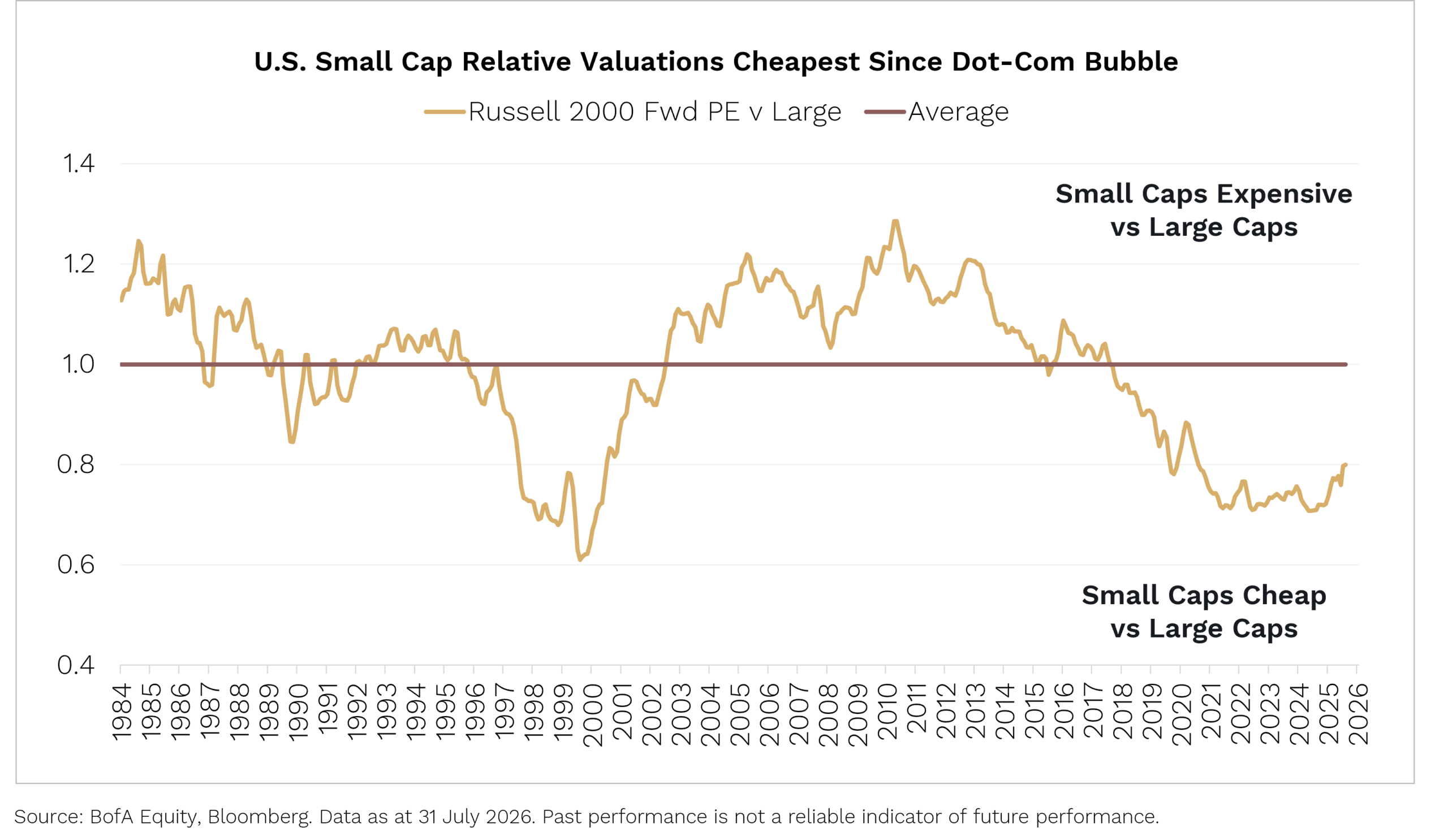
The final ingredient in the mix is that, despite US small caps outperforming large caps since late last year, relative valuations (price-to-earnings ratios) still scream great value for US smalls.
Keeping our bathers on
In sum, July was a stinker for momentum, semiconductor and memory stocks. Yet our Global Funds protected most of the value they had gained the previous year. It was a great test of the downside protection we have spent years building into those Funds.
We will keep doing what we always do: working our butts off meeting companies, digging into their ecosystems, and hunting for the earnings surprises the market hasn’t found yet.
And, just as importantly, making sure our bathers are on when swimming in the investing waters!
As always, if you’d like to chat to us about any of the Funds, please feel free to call us on (02) 8188 0397 or email us at ophir@ophiram.com.
Thank you for entrusting us with your capital.
Kindest regards,
Andrew Mitchell & Steven Ng
Co-Founders & Senior Portfolio Managers
Ophir Asset Management