A Sensient Being
Next time you’re in a US supermarket, have a look at the cereal aisle. The fruit loops, the rainbow lollies and the bright blue sports drinks get their colour from synthetic dyes like Red 40, Yellow 5 and Blue 1. These dyes are made from petroleum. They’re cheap and stable, and you only need a tiny amount.
That’s now changing. Between a Walmart deadline, a federal ban, a wave of state laws and pledges from the largest food companies in America, synthetic dyes are being taken out of the US food supply. Something has to replace them.
Behind many of those replacements sits a 144-year-old company in Milwaukee, Wisconsin: Sensient Technologies (NYSE: SXT). It’s one of the world’s largest makers of food colours, and natural colours are what it does best.
We built a position after the stock fell around 10% on the day of Sensient’s September quarter result. We think that gave us one of the better entry points we’ll get into a structural growth story that, on our numbers, can double 2025 operating earnings within three to four years.
Finding Sensient
We found Sensient while doing the work on another company.
We had travelled to Wisconsin to meet Badger Meter (NYSE: BMI), a water metering company. It’s a business we like in its own right, and it’s also a close peer of two electricity metering businesses we own in the Funds.
We hate leaving a meeting slot empty. So before the trip we contacted several companies in the state in our “hitting zone” to fill up our schedule. We came across Sensient as part of that wider search.
We often get asked what type of screens we run at Ophir, but we don’t limit ourselves to screens. Meeting companies in person is a key component of our idea generation and it’s a big part of why we spend so much time on the road. The other key advantage to this approach is the positive selection bias inherent in the companies that accept our meeting requests. If a company has a good story to tell, it wants to tell it.
On this trip we met with a business most investors file under “boring ingredients”. But what we found was a company set to benefit from one of the biggest reformulations of the American diet in decades.
Why natural colour is worth ten times more
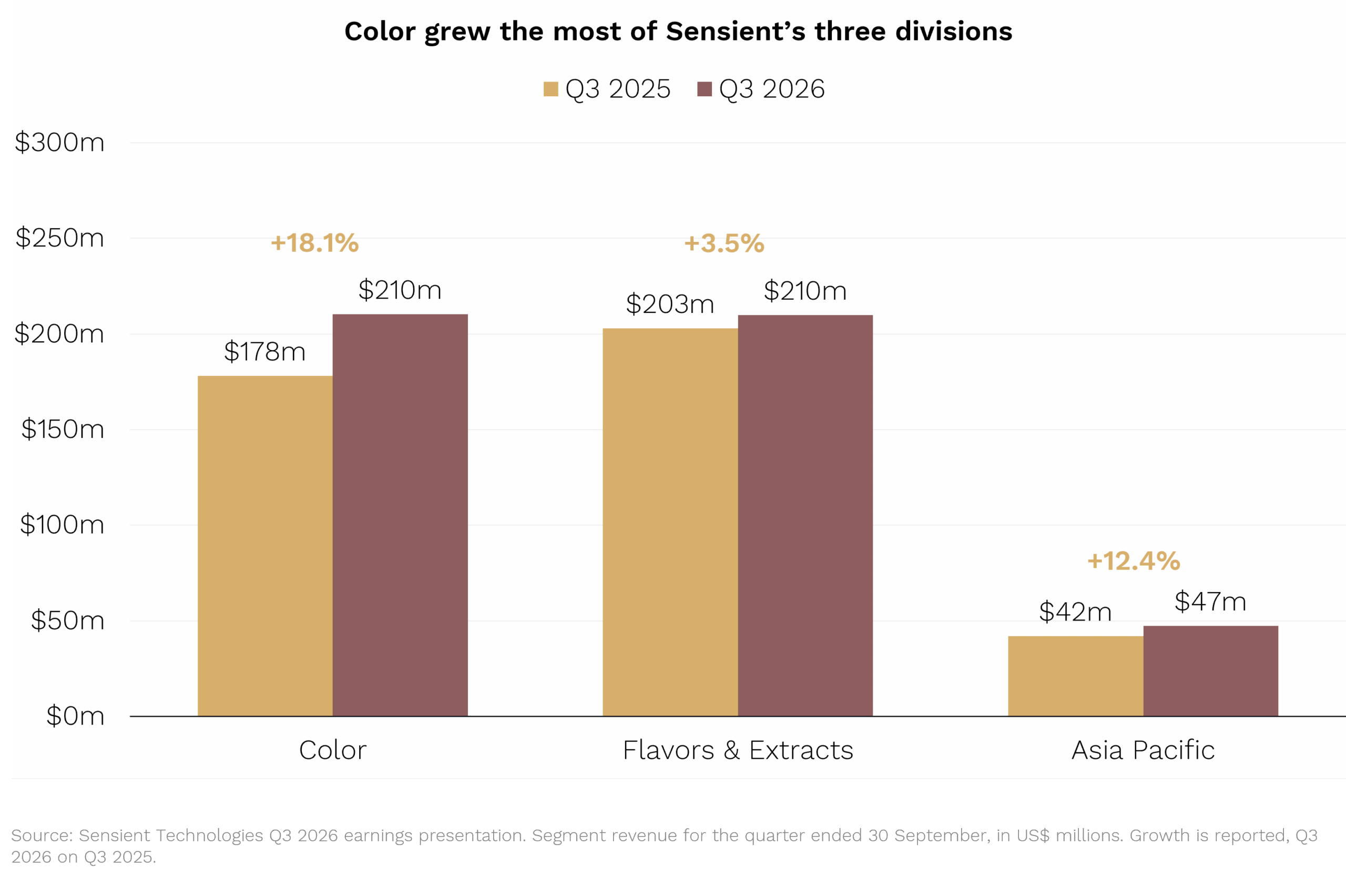
Sensient has three divisions: Color, Flavors & Extracts, and Asia Pacific. Color is the largest by profit. It made US$210 million of revenue in the September quarter at a 25% EBITDA margin.
The key point is simple. Natural colours come from vegetables, fruits and algae: beetroot and purple carrot for reds, turmeric and paprika for yellows and oranges, spirulina for blues. They’re much harder to use than synthetic dyes. You need far more of them, and they can fade or change shade with heat, light and acidity. Getting a natural red to stay red in a fizzy drink on a shop shelf for six months is a technical problem, and solving it is Sensient’s job.
That’s why the economics are so different. On our analysis, every dollar of synthetic colour Sensient sells today becomes roughly ten dollars of revenue once it’s converted to natural. Sensient sells around US$100 million of synthetic colours in the US. Management’s target is US$1 billion of additional natural colour sales as the company exits 2028.
The deadlines are real
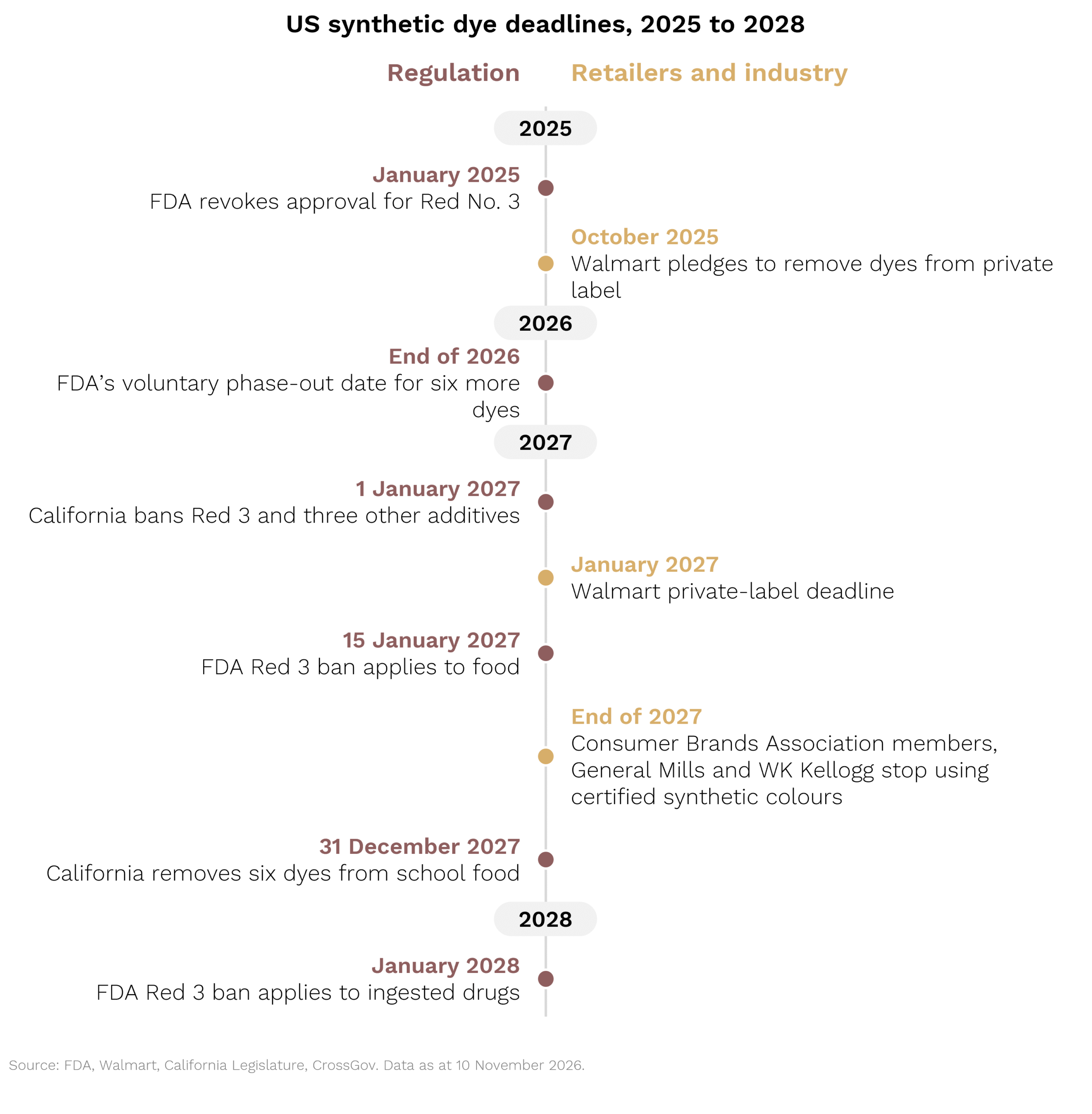
This isn’t a hoped-for consumer trend. There are hard dates in the calendar:
- January 2025: the US Food and Drug Administration (FDA) revoked approval for Red No. 3. The ban applies to food from 15 January 2027 and to ingested drugs from January 2028.
- October 2025: Walmart committed to removing synthetic dyes and around 30 other ingredients from its private-label foods, including Great Value, by January 2027.
- 1 January 2027: California’s ban on Red 3 and three other additives takes effect. A second California law removes six synthetic dyes from public school food from 31 December 2027.
- End of 2027: the Consumer Brands Association says its members will stop using certified synthetic colours, and General Mills and WK Kellogg have made the same pledge.
The federal government has also asked industry to phase out six more petroleum-based dyes by the end of 2026. That request is voluntary for now, but the direction is clear.
The states are moving too. West Virginia passed a sweeping ban on synthetic dyes that set off a wave of state-by-state reform. A judge has since paused part of that law, but by then many other states had started their own process. More than 150 state bills have been put forward across about 28 states.
Walmart matters more than any single regulation. As the largest grocer in the US, it can force its whole supply chain to act faster than any law. That pushes other large food companies to convert earlier than the regulatory dates require, because nobody wants a second recipe for one customer.
Three reasons we’re excited
-
Conversion is happening faster than expected
Sensient booked around US$30 million of new conversion revenue in the September quarter, taking it to about US$75 million for the year to date. Management puts the annualised value of conversions won so far at more than US$160 million. It also says around 85% of new US product launches in the quarter used natural colours. FDA certifications of synthetic colour batches fell nearly 10% over the past 12 months, which is an independent sign that volumes are shifting.
Color revenue grew 17% in local currency in the quarter, and Food & Pharmaceutical colours grew 22%.
-
The market is pricing the US and ignoring the rest of the world
The US$1 billion figure assumes Sensient gains no extra share from the change. It also gives no credit to adoption outside the US. Management has said that eventually nearly all of the synthetic colours it makes in the US will go to customers in Latin America and Asia Pacific, which tells you where they see the next leg. Latin America is already changing its rules. We think the global opportunity will prove much larger than the US one over time.
-
Growth you don’t have to pay up for
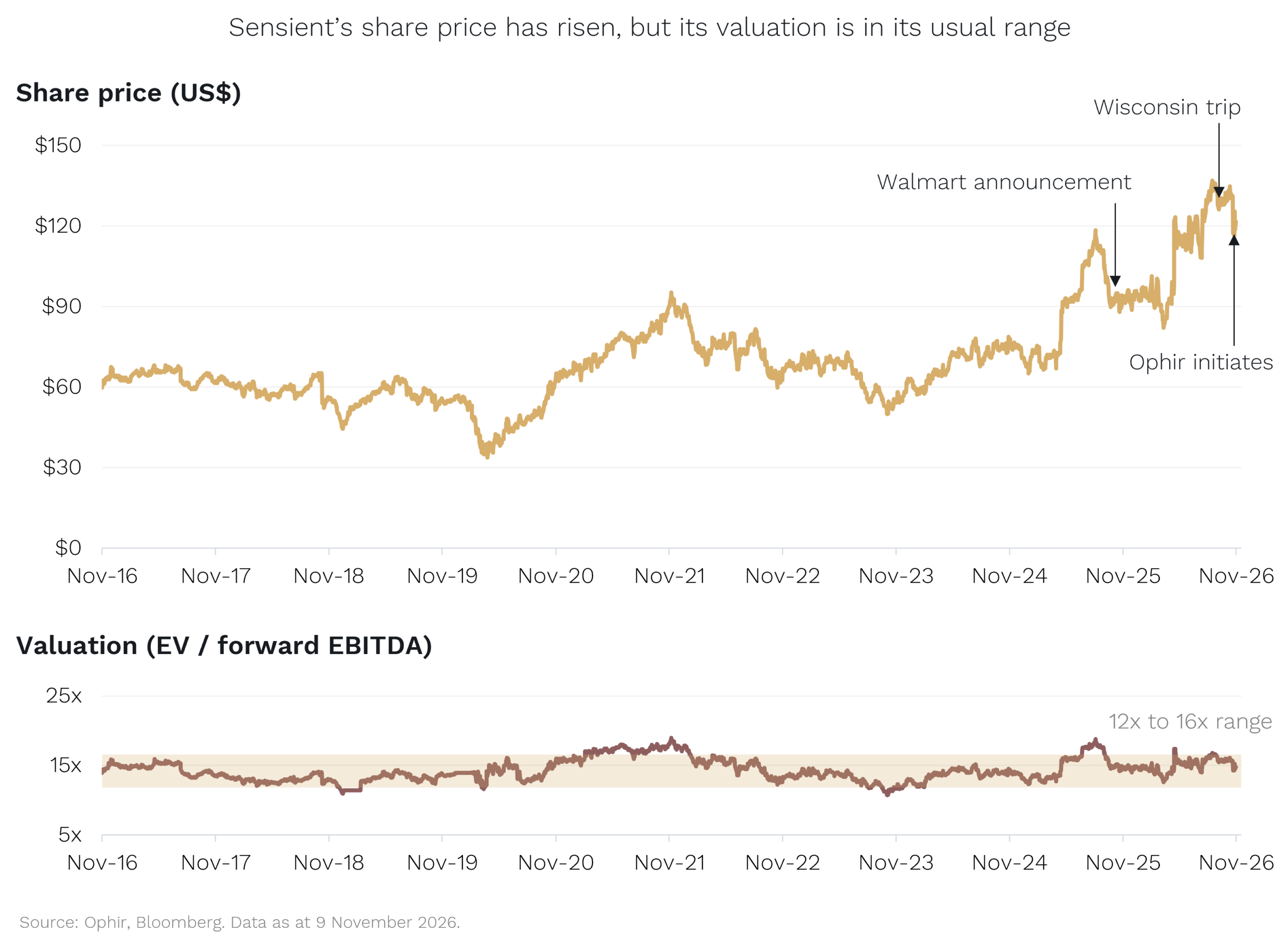
Even without conversion, the core business grows at mid-single digits. Add conversion and, on our numbers, the group compounds revenue in the mid to high teens for the next three years. Yet the stock is trading in the 12 to 16x EBITDA range it has held for most of the past decade (outside the COVID period).
Our edge
We’ve spoken to several customers and large consumer packaged goods (CPG) companies that are going through the conversion now.
We don’t necessarily think the US will convert every synthetic colour, and adoption may well slow once the first deadlines pass, especially if political enthusiasm for the Make America Healthy Again (MAHA) agenda fades. However, the customers we spoke to weren’t waiting for regulation. Walmart has moved first, and the large CPGs are following because their own consumer research tells them to.
Sensient’s own research involving more than 12,000 consumers supports this. Shoppers link natural colours with higher quality and will pay more for them, as long as the product still looks the way they expect. That’s why matching the shade is everything, and that’s Sensient’s strength.
The numbers and why we bought on the dip
Sensient’s September quarter result was strong. Revenue rose 10%, adjusted EBITDA rose 15% and adjusted EPS rose 18% in local currency terms. Management reaffirmed its full-year guidance and raised the bottom of its GAAP EPS range to US$4.15 to US$4.20.
We were concerned that expectations were a little too high going in, as conversion was never going to arrive in a straight line. Large food companies are known to change launch dates. So when the stock pulled back, we took the opportunity.
Applying the bottom end of Sensient’s historical 12 to 16x trading range to 2028 EBITDA gives ~40% upside on our numbers. This doesn’t assume any multiple expansion or give any benefit from international conversion beyond what’s already won. Any buybacks and M&A once capex peaks in 2027 would also be additive.
What could go wrong
The main risk is timing. If US adoption stalls after the first deadlines, or regulation is watered down, the US$1 billion takes longer to arrive. Some state laws are already being challenged in court: parts of West Virginia’s ban and Texas’s labelling rules have been blocked.
On consensus numbers the stock is closer to 14.5x 2027 EBITDA, so new investors are paying for some of the ramp. Sensient is also investing heavily. It’s spending about US$250 million on natural colour capacity, mostly in 2026 and 2027, and building inventory ahead of launches. Net debt is 2.3x EBITDA and free cash flow will be thin until 2028, so buybacks are on hold.
We would review our thesis if:
- Conversion wins stopped coming through;
- Large customers pushed back their 2028 dates in bulk; or
- Margins on new natural volumes came in well below the Color division’s mid-20s.
Why it fits now
As the market looks for growth outside AI, we think the most attractive opportunities are businesses with a structural, dated catalyst that the market still prices like an ordinary ingredients company. That’s exactly what Sensient is.