House call
We spend what feels like half our lives chasing companies and management teams around the world, at a pace of around 1,500 meetings a year. So it’s always a little disconcerting when a company comes looking for us.
When it happens, there are usually two reasons. Either the company feels its story isn’t landing with the market and thinks it will land with us, perhaps because of a business we own or a shared connection. Or it needs to raise capital.
The second is far more common. Still, with only a low single-digit percentage of the companies we meet ever making it into the portfolio, an inbound call has better odds than our usual, more laborious hunt.
Aveanna Healthcare (NASDAQ: AVAH) was the first kind. It is the largest provider of paediatric home healthcare in the US, caring for medically complex children who would otherwise live in hospital.
We built our position this year as one of its private equity owners sold down, taking our first shares at US$6.24 in June. That initial stake has nearly doubled, and we think the earnings story has further to run.
One of the good guys
Aveanna’s CEO, Jeff Shaner, was playing golf at an industry charity day with the CEO of another healthcare company we own. Three years into turning Aveanna around, he was frustrated that he couldn’t get investors to listen or convince them the business had broken the back of its problems.
His playing partner told him to call us, describing Ophir as “one of the good guys”. We later learned this meant two things: we do the real work, and we aren’t jerks. Apparently the second is rarer in our industry than you’d hope.
Our first meeting was virtual, in late 2025. What we found was a business that had repaired itself, on a share price that still reflected the crisis.
What Aveanna actually does
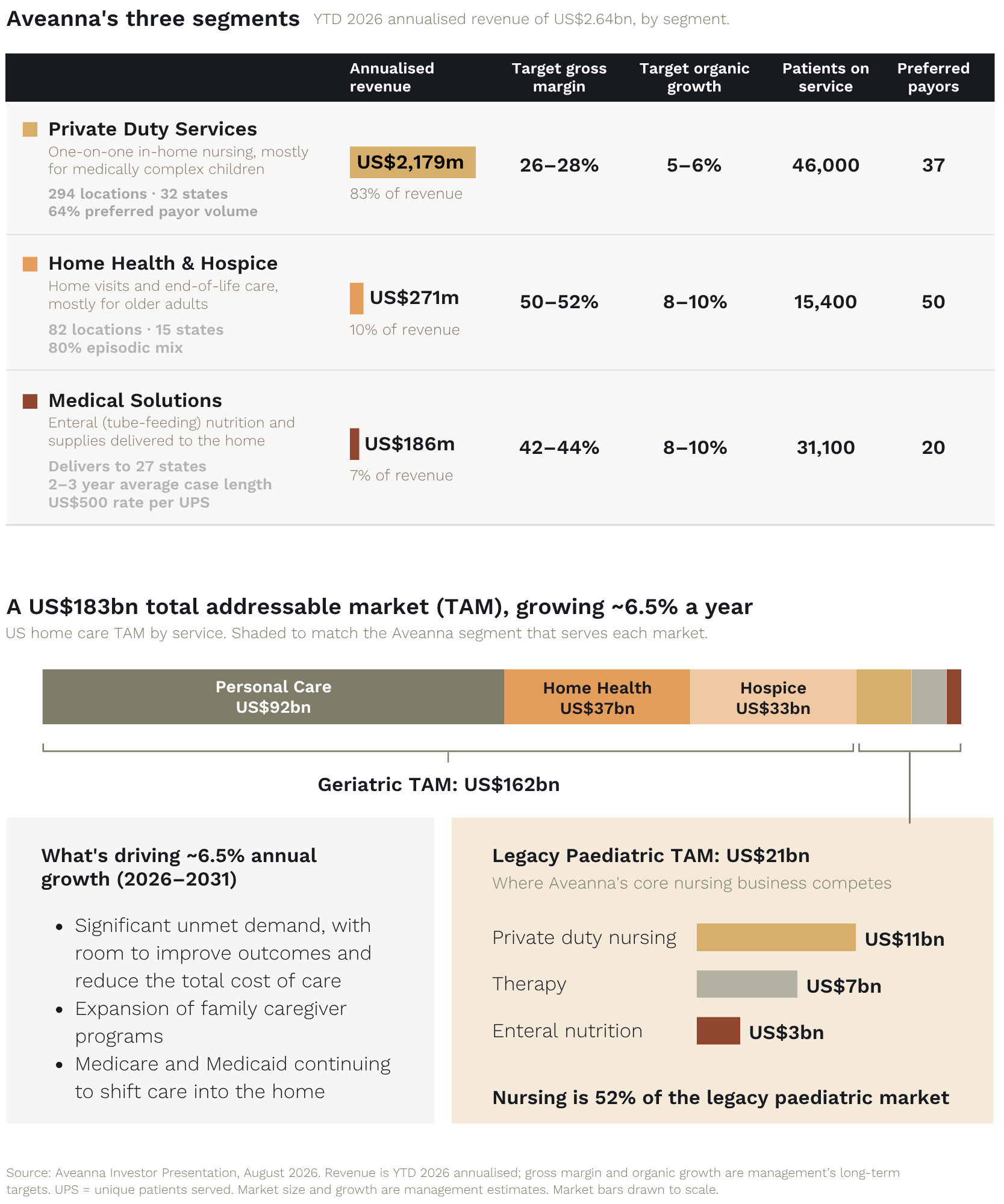
Aveanna’s core is private duty nursing (PDN): one nurse caring for one patient, often a child dependent on a ventilator, tracheostomy or feeding tube, for an entire shift at home. This Private Duty Services segment generates more than 80% of revenue and cares for 46,000 patients.
Home health, hospice and the delivery of enteral nutrition supplies make up the rest, and across the group Aveanna employs around 30,000 caregivers in 39 states.
The economics are simple. A Berkeley Research Group study of California’s Medicaid program estimated that caring for these children at home costs around 90% less per day than keeping them in hospital. Yet in a national survey of families with ventilator-dependent children, nearly half received less than half of the nursing hours their insurer had approved.
Demand isn’t the constraint. Nurses are.
Medicaid, the joint federal–state health program for low-income Americans, funds 81% of Aveanna’s revenue. Much of that money flows through private insurers that run Medicaid on the states’ behalf, known as managed care organisations (MCOs). The rates they pay set how much Aveanna can offer nurses, which decides how many it can hire.
For Australian readers, the closest parallel is the NDIS. Government sets the price, and a fragmented field of providers competes for a scarce workforce.
Priced for the past
Aveanna listed in April 2021 at US$12, after cutting its price range from US$16–18. In 2022, nurse wage inflation collided with frozen Medicaid rates and a floating-rate balance sheet. Adjusted EBITDA fell from US$184 million to US$129 million, with the shares down ~90% that year.
By early 2026 the business had more than recovered, with 2025 adjusted EBITDA of US$321 million. Yet the stock traded on around 9x EBITDA and 13x earnings, held back by fear of Medicaid cuts, leverage of ~4x and a ~20% shareholder, private equity firm J.H. Whitney, that was selling.
The market was still pricing a broken, over-levered private equity float. We saw a scaled provider that saves states money, and believed two of those three discounts would fade within 12 months.
Three reasons for earnings upside
-
Rate rises that pay for themselves
After years of frozen rates, states are catching up. Aveanna won 10 state PDN rate increases in 2025 and seven more by mid-2026. Higher rates fund higher wages, which bring in more nurses, who deliver more of the hours families have already been approved for.
States earn a return too. Our work suggests every US$100 million of extra nursing spend saves a state US$200–300 million in avoided intensive care and emergency costs. And the biggest prize is still to come: after four years of lobbying, California’s budget funds a significant increase in paediatric PDN rates from 1 January 2027, the state’s first since 2018.
-
The preferred payor flywheel
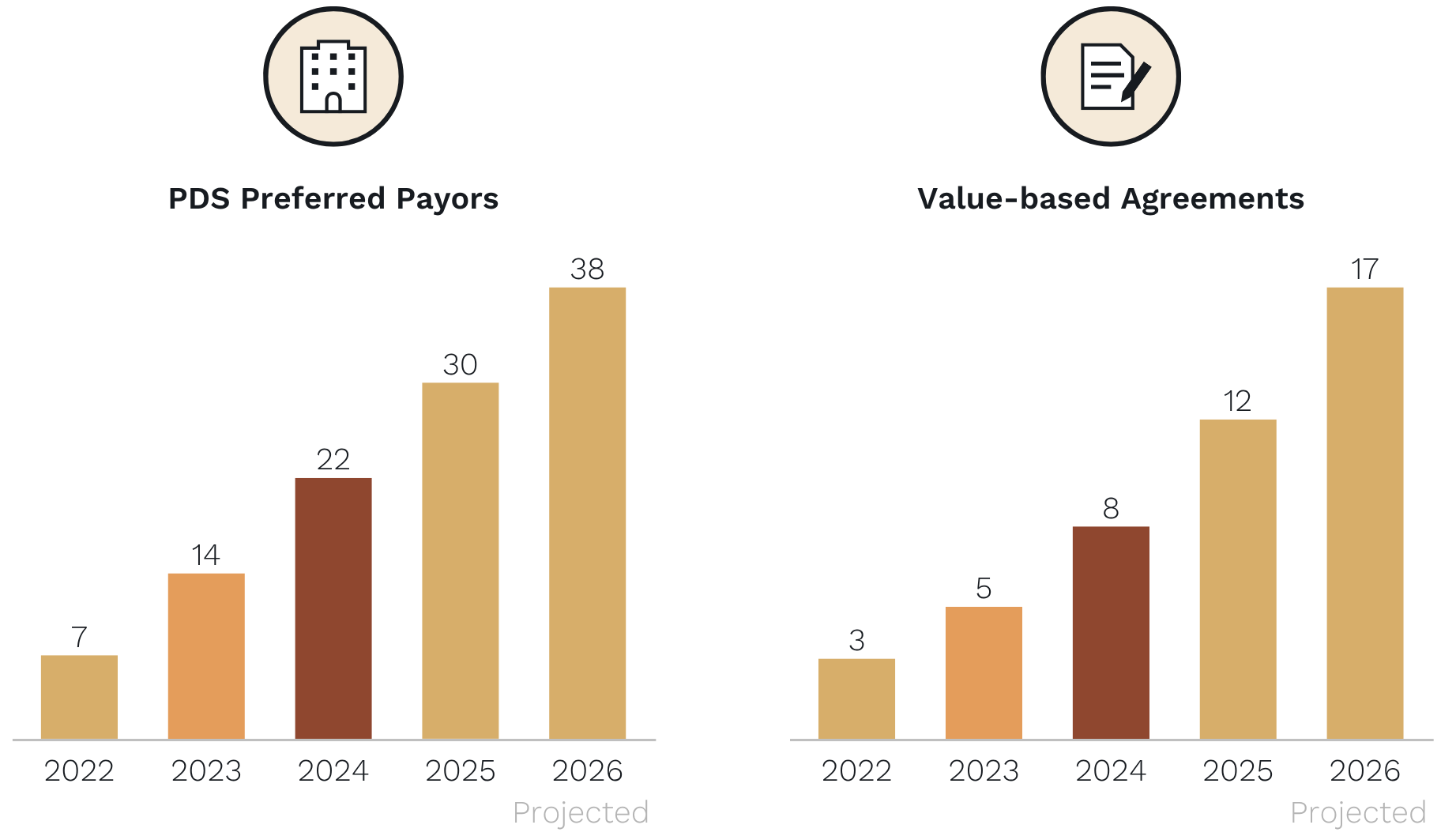
Aveanna now directs its nurses to the MCOs that pay enhanced rates and offer consistent volume, in exchange for reliable staffing and measurable outcomes. These preferred payor agreements covered 35–40% of Aveanna’s private duty managed care volume in 2023. By mid-2026 the share was 64%, against a long-term target of 80%.
The model compounds as more states move to managed care, because MCOs increasingly want fewer, larger partners. Value-based agreements, which pay Aveanna partly on patient outcomes, have grown from three in 2022 to a projected 17 this year, while the number of preferred payors has grown from seven to a projected 38.
Source: Aveanna Investor Presentation, August 2026.
-
Deleveraging that flows straight to earnings
Leverage has fallen from distressed levels in 2022 to ~4x at the end of 2025, and is forecast to keep falling. In May, Aveanna repriced its term loan, cutting the rate by 75 basis points, and Moody’s has since upgraded its credit rating.
Interest expense was ~US$140 million in 2025 and fell 25% in the first half of 2026. We expect it to reach ~US$90 million by 2027, adding ~20 cents of EPS, a ~30% uplift on where consensus sat at the start of the year.
Doing the work, then waiting
After that first meeting, we followed up with management after the J.P. Morgan Healthcare Conference in January, when Aveanna pre-released its 2026 guidance, then met virtually several more times through the first half to make sure the operating momentum was holding. The consistency and depth of the team stood out. The company runs more like a US$10 billion business, with the nimbleness of a small cap growing into a large, fragmented market.
We held multiple meetings with listed peers Pennant Group (NASDAQ: PNTG) and Addus HomeCare (NASDAQ: ADUS) to test Aveanna’s management quality, its strategy of working with MCOs to lift rates state by state, and its Medicaid positioning. Everything came back consistent with our expectations. We also mapped Aveanna’s footprint against each state’s reimbursement history, budget cycle and regulatory risk.
Then we waited for the seller. On 3 June, J.H. Whitney sold 5.8 million shares at US$6.24, and we used this opportunity to build a 2.1% starting weight. We deliberately left room to build towards 5% as catalysts landed and the overhang cleared, expecting further sell-downs. The next came in August, with a placement at US$11.75.
The upgrades keep coming
Adjusted EBITDA guidance for 2026 has been raised three times this year, once to include an acquisition, from US$318–322 million to more than US$365 million.
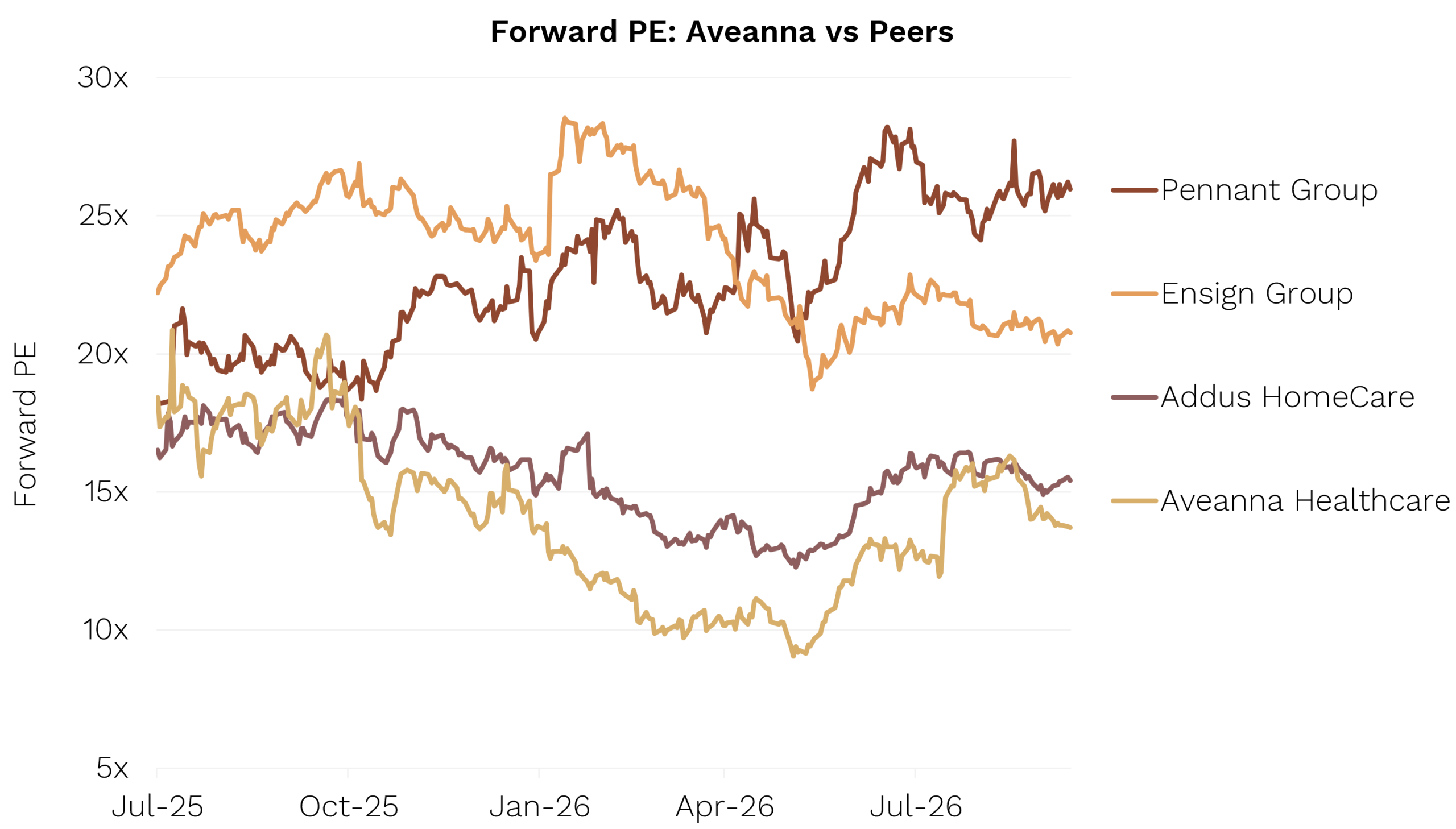
As at 30 September 2026, Aveanna traded on ~15x consensus 2026 EPS and ~13.5x 2027, while listed peers Addus, Ensign Group (NASDAQ: ENSG) and Pennant traded on ~16x, ~22x and ~27x forward earnings respectively.
Source: Bloomberg data as at 30 September 2026.
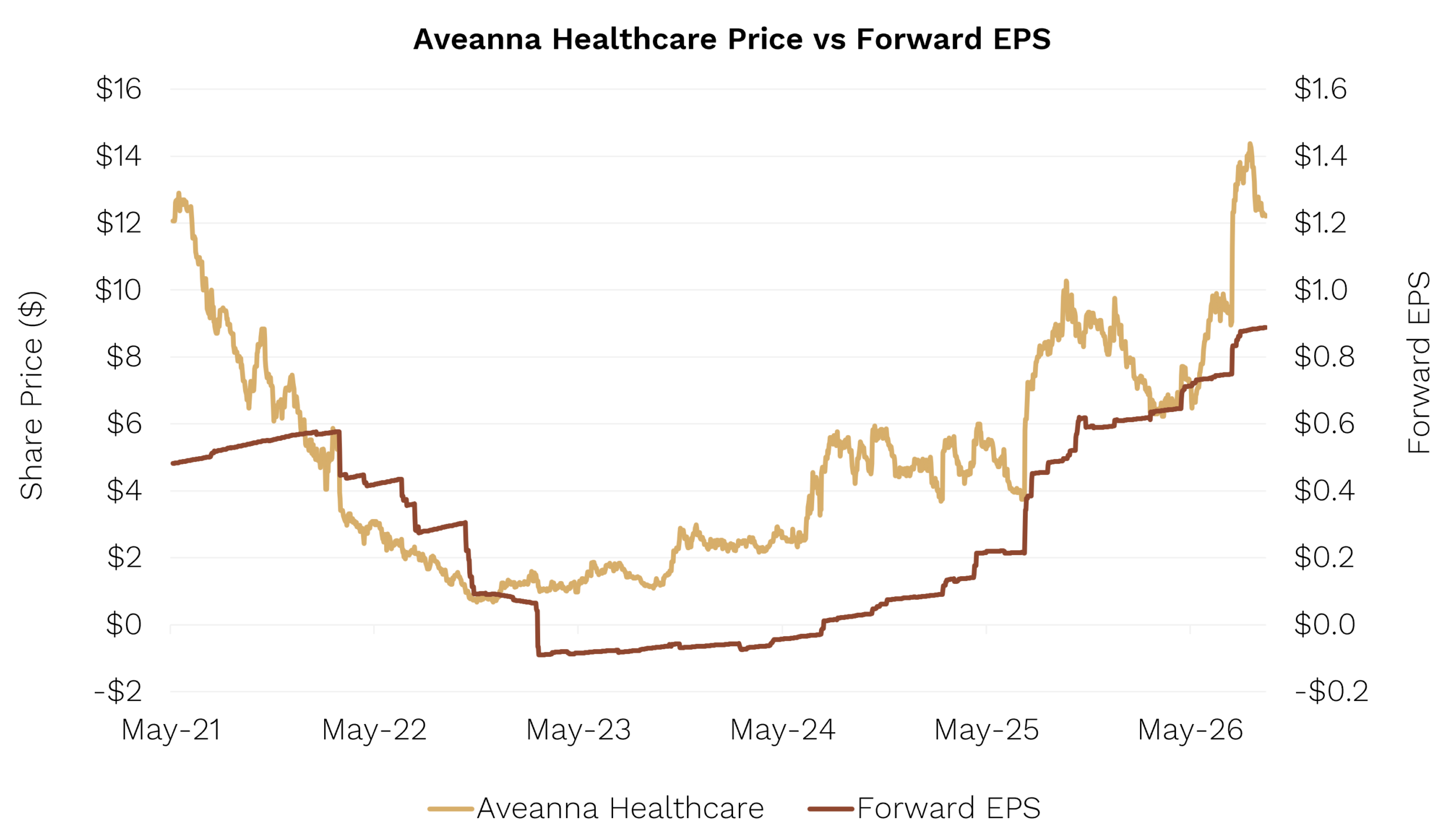
We think 2027 consensus is too conservative. On our numbers, consensus doesn’t yet fully reflect California’s rate increase, a full year of the US$175.5 million Family First Homecare acquisition, lower interest and a richer payor mix.
Source: Bloomberg data as at 30 September 2026.
What would make us sell
The biggest risk is state budgets. The One Big Beautiful Bill Act tightens how states fund Medicaid over the coming years. If rate catch-up turned into rate cuts, the thesis would be broken. That said, prediction markets now point to a Democratic sweep at the 3 November US midterms, which reduces the tail risk of cuts.
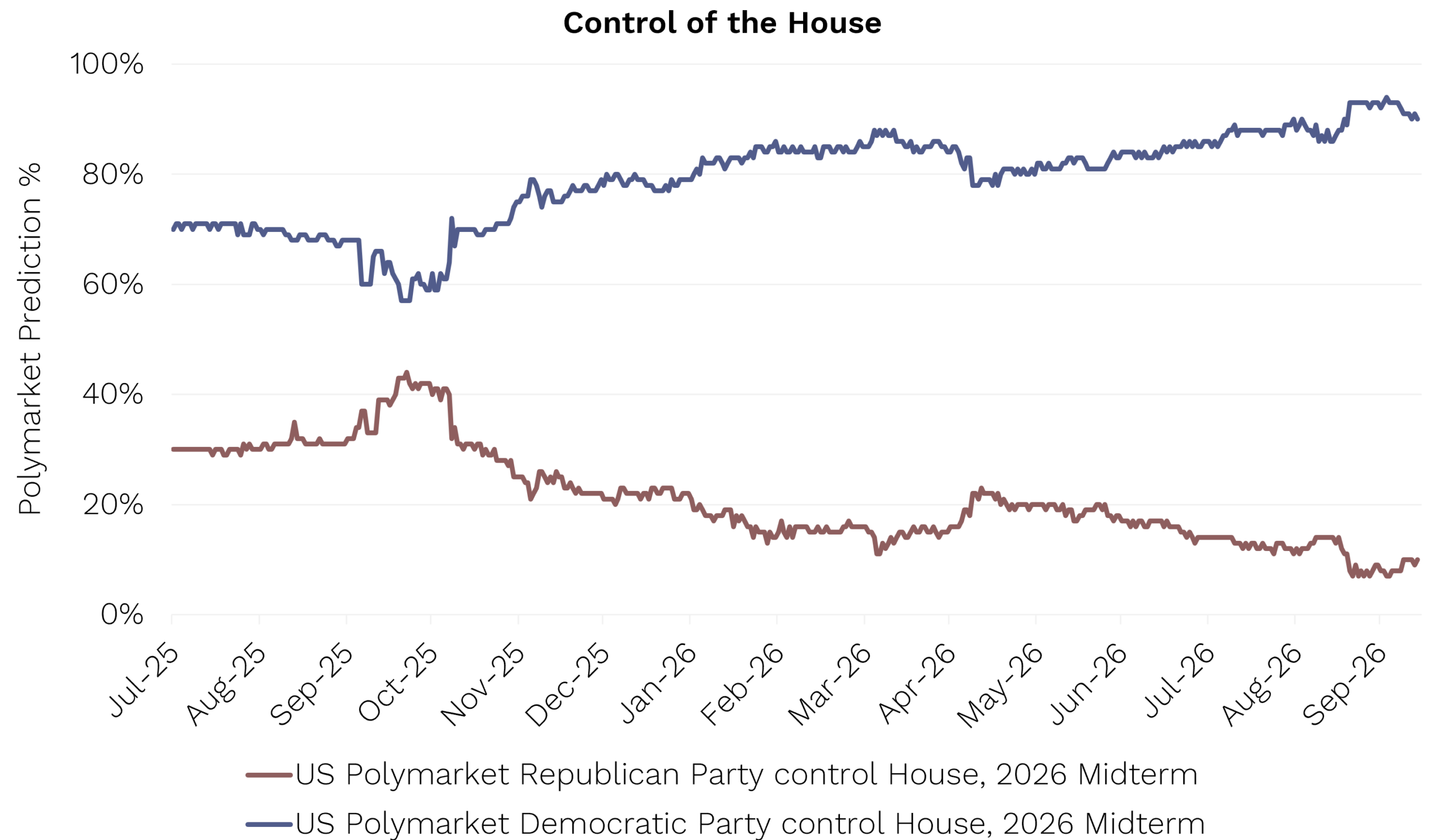
Source: Polymarket data as at 13 October 2026.
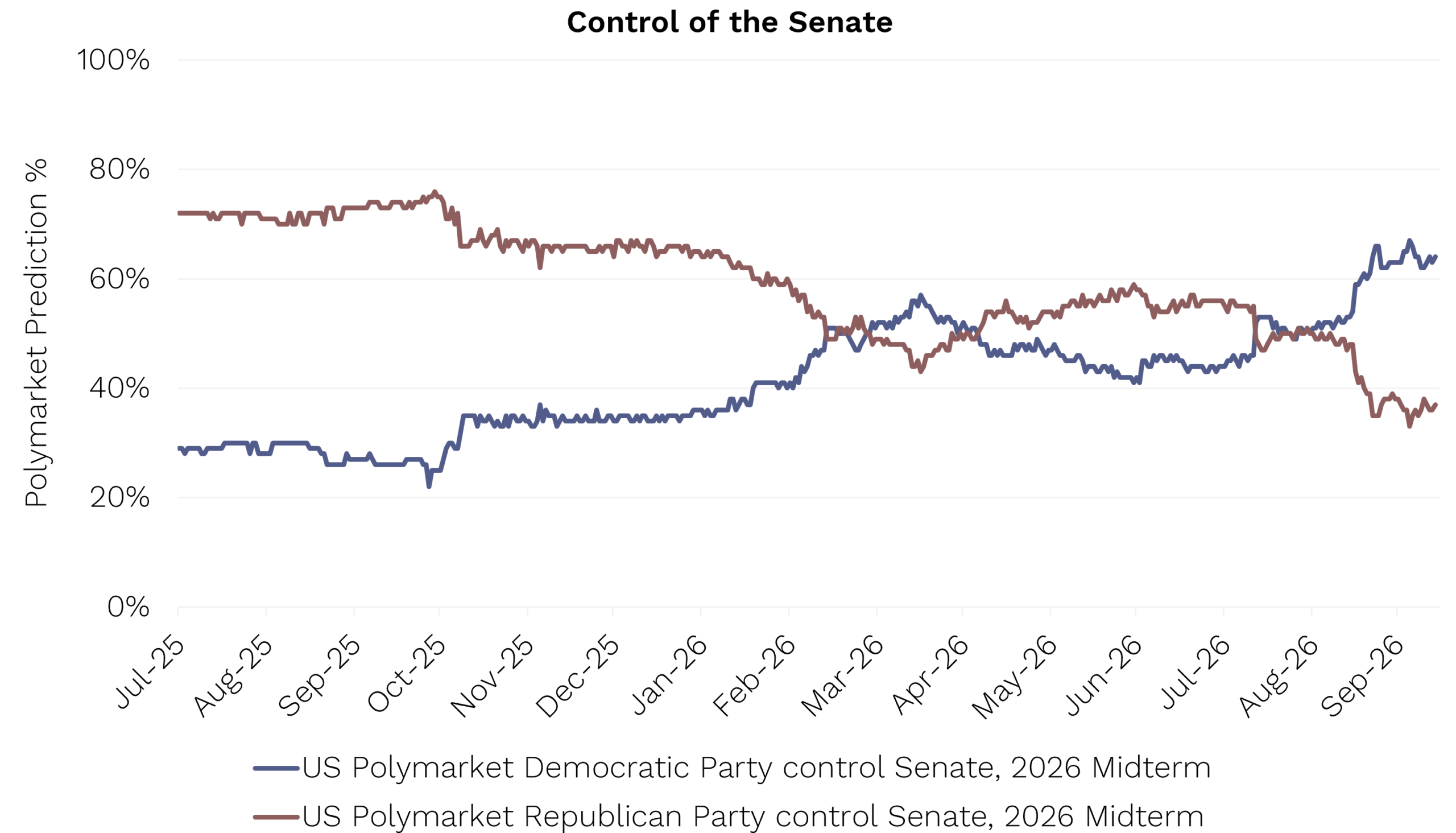
Source: Polymarket data as at 13 October 2026.
We also watch wages against rates through private duty gross margin, which fell to 28.9% in the June quarter from 32.5% (the prior year included ~US$9 million of timing benefits). A US$880 million interest rate cap also expires in February 2027, so part of the interest saving depends on where US rates sit.
Care that can’t be coded
In a market preoccupied with which jobs AI will replace, Aveanna’s product is a nurse at the bedside of a ventilated child. It can’t be automated, offshored or downloaded. Its growth depends on states choosing the cheaper, better option for their sickest children, and more of them are making that choice with every budget cycle.
We spend what feels like half our lives chasing companies. Every now and then, one makes a house call.